
In an era defined by fragmenting supply chains, tightening geopolitical tension, and strategic autonomy directives, European deep tech startups face an existential fork in the road: should they build their manufacturing capabilities at home, or rely on global contract producers to scale fast?
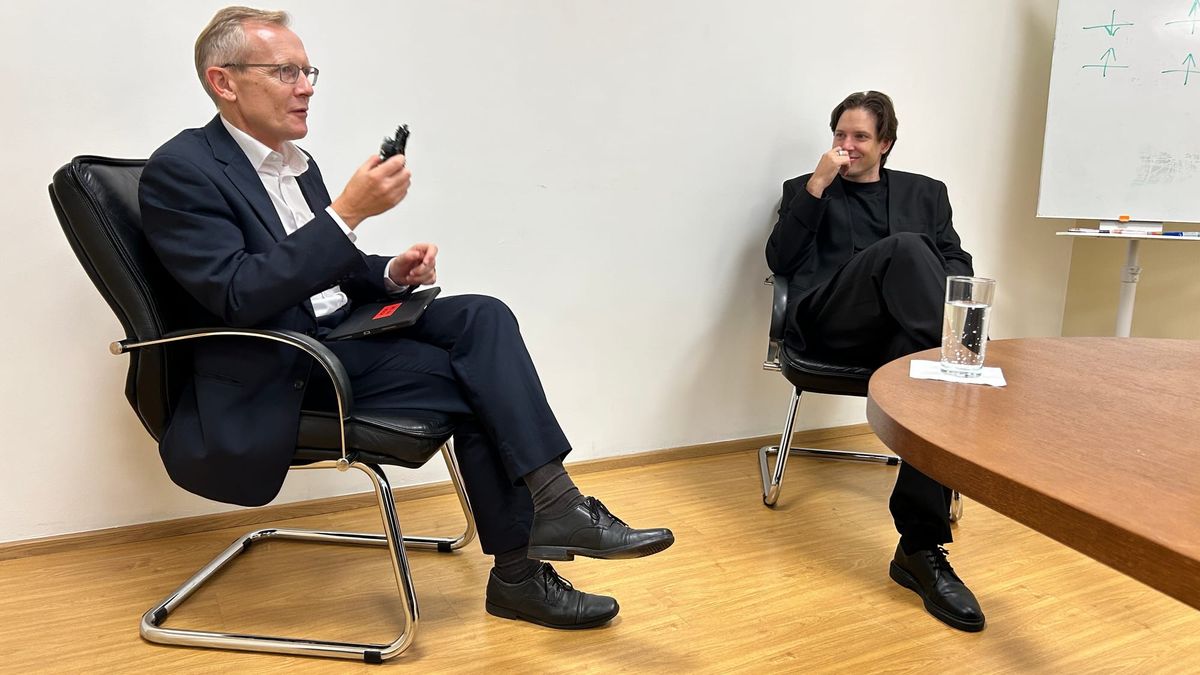
During a recent fireside discussion in Tallinn, Professor Tim Minshall, Head of the Institute for Manufacturing (IfM) at the University of Cambridge, and Dr. Ivar Kruusenberg, Founder and CEO of PowerUP Energy Technologies, explored the realities of scaling physical products in Europe, supply chain vulnerabilities, and the missing link in national innovation strategies.
Leaving Silicon Valley to build in Europe
For many hardware founders, the default playbook has long been to seek venture capital and market access in the United States. However, Kruusenberg’s trajectory with PowerUP — a company developing hydrogen fuel cell generators — took an unconventional turn. Founded while he was working at UC Berkeley in California, the company ultimately decided to shift its core operations back to Estonia.
“We understood in the US that the American Dream is not so beautiful as we see here from Europe,” Kruusenberg said. “The market was opening up much faster over here, and I didn’t have a green card or US citizenship, which meant that right when we started PowerUP, national funding rules tightened. So we moved it to Europe to get it going.”
The move highlighted Estonia’s distinct structural advantages as an agile testing ground. Born out of the need to rebuild state infrastructure after 1991, the Baltic nation skipped legacy systems altogether to create an integrated digital society.
“Estonia is just such a small country where people know each other,” Kruusenberg noted. “After the Soviet Union collapsed, we had to build everything up from scratch, learning from others’ mistakes. This has allowed us to digitalise faster — everything from tax declarations is automatic. It makes things move much easier and faster.”
Professor Minshall emphasised that European entrepreneurs often underappreciate local scaling speed, defaulting to Silicon Valley out of habit.
“We have so many of our younger entrepreneurs — coming from Cambridge, there’s a lot of them — who head straight to the US,” Minshall observed. “The belief is: ‘If I want to scale my business, I can mess around in the UK, and it will be okay, but if I really want to move fast, I have to be in the US.’ Hearing someone who has gone there, seen it, and said, ‘No, the faster route to market is in Europe’ is extraordinary.”
The kettle switch lesson: Retaining the core
When deep tech startups begin scaling physical products, one question dominates boardrooms: Should manufacturing be kept in-house or outsourced?
To answer this, Minshall brought out a deceptively simple piece of hardware: a bimetallic control switch invented by Dr. John C. Taylor, the mechanism present inside billions of electric kettles worldwide.
“This is the technology that switches off your kettle,” Minshall explained, demonstrating the small metallic blade. “It’s a fail-safe, 99.999% reliable technology that cannot fail. John C. Taylor designed the product, but then he worked out that the value is in the manufacturing. He built the custom machines that make this. Those machines, designed in the 1980s, still operate today on an island in the Irish Sea — the Isle of Man.”
While plastic enclosures and copper bending are assembled via contract partners in Shenzhen, the core bimetallic manufacturing process is never allowed to leave the proprietary factory.
“The value of the business is not just in the technology; it is absolutely in the knowledge that goes with the production of that, and they will not release that,” Minshall stressed. “For startups, the core technology must be manufactured in-house because that is where your value sits.”
Geopolitics, space, and the (not too-) hidden risk in batteries
The argument for localised, secure manufacturing becomes even sharper in dual-use, space, and defence markets. PowerUP has derived significant revenue from European Space Agency (ESA) contracts, but also from defence-related applications — sectors with stringent supply chain sovereignty mandates.
“Space is a big part of our business because we have five ongoing projects with ESA,” Kruusenberg said. “ESA has heavy restrictions on getting materials and equipment from outside Europe, and specifically, they are not happy about anything ordered from China.”
This creates severe friction for hardware producers relying on standard components, particularly lithium-ion battery packs.
“We are battery-agnostic, but the lithium-ion battery supply chain is a major concern,” Kruusenberg warned. “Batteries today are not just simple cells; they have fancy control electronics inside that monitor them from your phone. Which means that this battery pack can potentially be controlled by whoever manufactured it. I don’t believe our society has truly understood what we are tied to and how fragile this supply chain is.”
Minshall concurred, noting that software supply chains and component compliance now represent equal threats:
“It’s not just the bill of materials, assembly, and hardware components—there is the parallel software stack as well. Issues of compliance, checking where the code in a battery pack comes from, and who has access to it is a massive vulnerability.”
Breaking the bottleneck: Defence demand and the Swedish Blueprint
Why have European deep tech companies historically struggled to scale into global manufacturing powerhouses? Minshall attributes part of the problem to a long-standing cultural narrative around industry, particularly in the UK.
“If the word ‘manufacturing’ appeared on the news in the 1970s or 80s, it was about a factory being shut down, industrial action, or dirty, miserable unhappiness,” Minshall said. “That is a cultural legacy we carry. But the reality is simple: if you want products and systems that make life better, the way you translate science and technology into those products is through manufacturing.”
Today, defence requirements are forcing a rapid re-evaluation of industrial capacity across Europe. Minshall cited UK startup Cambridge Aerospace, which developed high-speed interceptors and secured direct procurement contracts from the Ministry of Defence.
“They got a contract saying ‘you make, we buy’. Suddenly, they went to venture capitalists and raised €300 million to build manufacturing locally in the East of England. A guaranteed customer with a chequebook reduces investment risk instantly.”
Kruusenberg pointed to Sweden’s industrial history as a model for holistic ecosystem planning:
“Sweden has been so successful because they look at the broader picture,” Kruusenberg explained. “From mining raw materials down to local refineries, building the trains, and having local companies develop drilling equipment. They didn’t focus on just one isolated startup, but on the surrounding industrial ecosystem.”
The missing component: Strategic skills roadmaps
To replicate integrated industrial success, both speakers agreed that European states must address human capital constraints.
“We need to stop being so passive and giving so much unrestricted freedom in university quotas,” Kruusenberg said. “We need a broader plan to see where we will need people five years from now. If we know an engineering or defence firm is expanding in three years, we need to fund and direct students toward mechanical engineering and advanced manufacturing operations today.”
Minshall highlighted that tech development strategies fail without corresponding talent pipelines.
“Alongside technology roadmaps, there needs to be a skills roadmap,” Minshall concluded. “If we wish a capability to exist in three to five years, we must train the workforce now. Countries like Singapore and China move in an agile way because they align state education directly with industrial planning. Europe must build that same long-term vision if its deep tech sector is to thrive.”


Comments ()