
Estonian cancer AI caught four tumours radiologists had missed
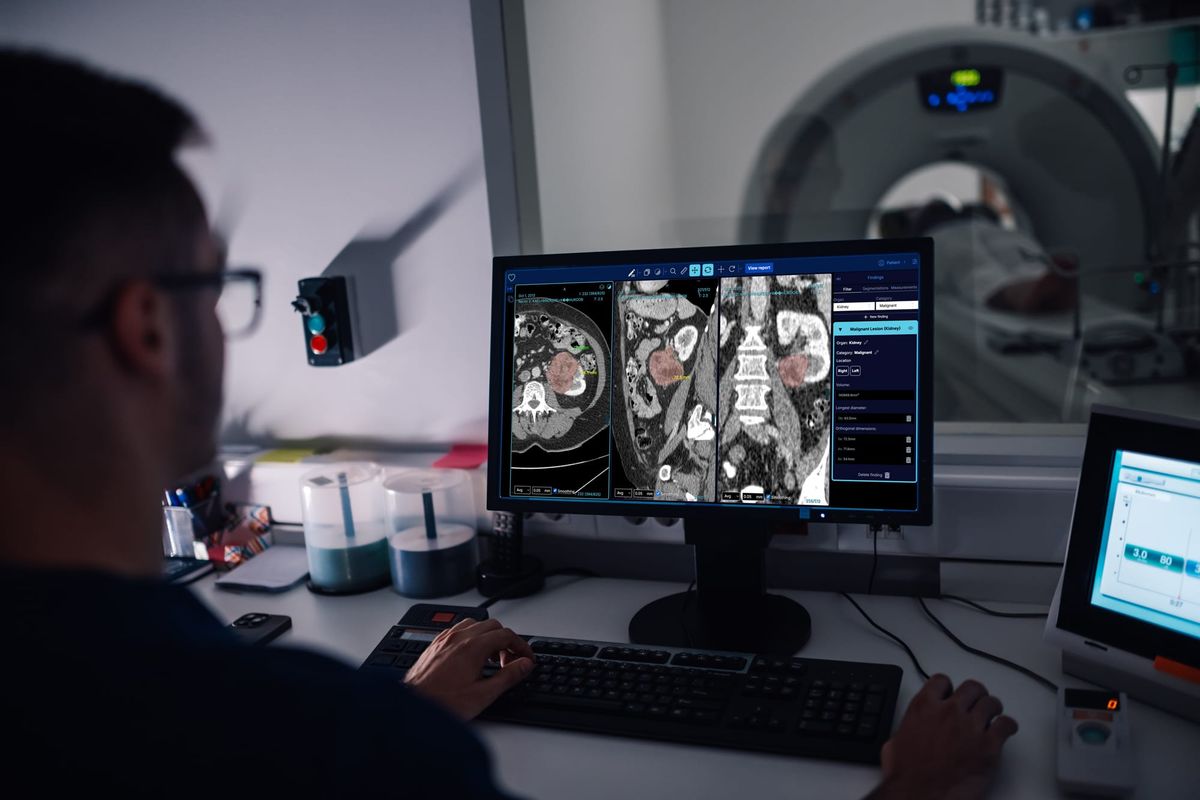
TARTU - During a six-month deployment at Tartu University Hospital, an Estonian-built artificial intelligence tool flagged suspicious kidney lesions in four patients whose tumours had been overlooked in the original radiology reports.
Now, Better Medicine, the company behind the technology, is raising a seed round to take the same idea beyond the kidneys.
Over six months, BMVision Kidney analysed abdominal CT scans from 4,276 patients. Preliminary results show the AI flagged findings with signs of potential malignancy in 171 cases. In four, it highlighted kidney lesions that neither the initial assessment nor the radiologist’s report had identified.
For Better Medicine, those four cases are perhaps the clearest measure of what the technology is supposed to achieve.
“We do not measure the success of BMVision Kidney solely by the accuracy of the technology or its contribution to radiologists’ work, but also by the number of patients whose diagnosis and treatment journey we have directly influenced,” said CEO Priit Salumaa.
A second pair of eyes
Kidney cancer presents an unusual diagnostic challenge: it is often discovered by chance. According to a 2021 study published in Clinical Radiology, more than 60% of renal cancers are diagnosed incidentally, often during imaging performed for an unrelated medical reason.
This is precisely where Better Medicine sees a role for AI - not replacing the radiologist, but re-using the scans and adding another layer of scrutiny to scans that are already being taken.
Professor Pilvi Ilves, head of the Radiology Clinic at Tartu University Hospital, said radiologists assess a CT examination as a whole, rather than focusing solely on the condition that brought the patient to hospital. She added that in an emergency setting, an AI tool working alongside the radiologist can provide additional reassurance by highlighting possible tumour findings.
For Better Medicine, this idea has already moved beyond development. BMVision Kidney is CE-certified under the EU Medical Device Regulation and is deployed in hospitals in Estonia and Germany, with pilots underway in the UK and South Africa.
Kidney is only the opening move
Better Medicine’s bigger bet, however, is that kidney cancer is a starting point, not a product category.
The company is now raising a €5 million equity Seed round, with up to half of the round already committed by the European Innovation Council.
The capital is intended to move Better Medicine from a certified kidney cancer product towards a certified multi-organ abdominal cancer suite.
Liver, pancreas and lymph node modules are next on the company’s roadmap.
Behind that expansion is a patent-pending multimodal foundation model trained on CT images. Better Medicine says the technology should shorten the development cycle for each additional organ-specific model rather than forcing the team to start from scratch every time.
Its ambition also stretches beyond the models it builds itself.
Instead of trying to win every organ one by one, Better Medicine plans to license third-party AI for areas including lung, breast, prostate and brain cancer and combine those tools with its own products.
In other words, some of its potential competitors could eventually become suppliers to the same platform.
The endgame is a system capable of opportunistic full-body cancer screening through incidental findings from medical imaging scans that are already being taken anyway. Thus re-using the data for a secondary purpose.
From Tartu to a much larger market
That ambition addresses a problem considerably larger than kidney cancer.
More than 400 million CT examinations are performed globally each year, many for reasons unrelated to cancer. Better Medicine argues that some abdominal cancers can already be visible in those images before the disease becomes symptomatic.
The company’s investor thesis is therefore built around extracting more diagnostic value from scans healthcare systems already produce.
The new funding would be used to expand across the DACH region and the UK, build further health-economic evidence and take the company’s first steps into the US. Better Medicine is also exploring markets in the Middle East, India and Africa.
There is an economic argument alongside the clinical one.The case for earlier detection is economic as well as clinical. A health-economic model developed by Better Medicine with support from the Estonian Health Insurance Fund’s Innovation Grant estimates that treating kidney cancer detected at an early stage costs around €7,300. At a late stage, that figure can rise to as much as €109,000.
For Salumaa, however, the more immediate proof is already sitting in four patient files in Tartu.
The company set out to build software that could notice something a busy human might not.
For four people, it did.
https://fomo.observer/estonias-top10-healthtech-startups-in-2026/#/portal/signup


Comments ()