
The Estonian scientist who pulled off a US IPO trying to trigger a local biotech boom
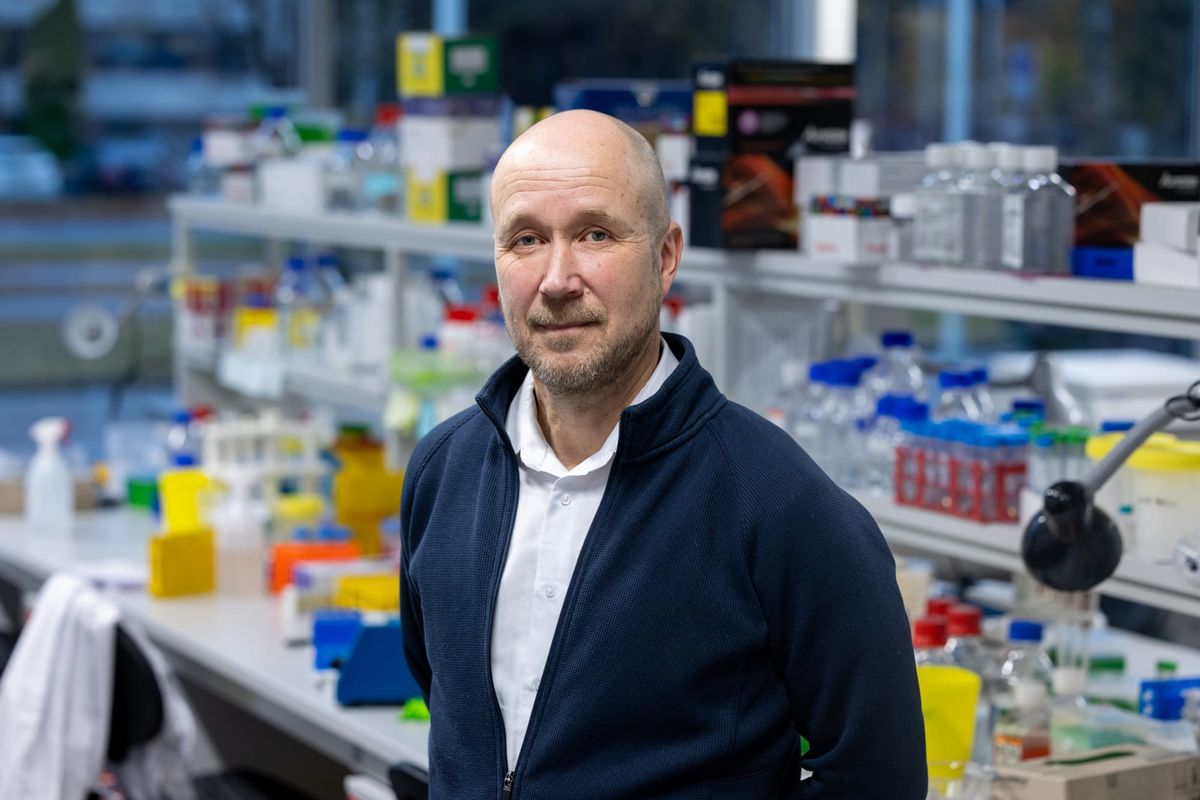
Tambet Teesalu's office sits one floor above the Laboratory of Precision and Nanomedicine at the centre of the University of Tartu. From its windows on a chilly, milky grey April day, one can see the faded green grass of an adjacent park and the roof of a supermarket.
When he was at the University of California, Santa Barbara, Teesalu had a different view. "You would look out and see the Pacific," he says, with the tiniest hint of nostalgia. "There would be waves and dolphins."
But this professor of nanomedicine, and biotech startup founder, has long since traded a view of dolphins for a flock of sheep. When he's not engrossed in developing precision cancer therapeutics and doing the tedious work of running a world-class laboratory, he's back at the farm about half an hour from the city, where he raises sheep, horses, and loads firewood into the barn.
With this aspect of his life, he's quite satisfied. "You just can't live like that in California," he says.
While Teesalu is no longer a Californian, his sun-drenched days at UC Santa Barbara, where he remains a visiting professor, and at the Sanford Burnham Prebys Medical Research Institute down the coast in La Jolla, have left an imprint. As have his experiences in developing the science behind and founding Cend Therapeutics, which in 2022 was acquired by Caladrius Biosciences in an all-stock deal valued at about $60 million. This allowed Cend to trade on the Nasdaq, and the entity was rebranded as Lisata Therapeutics, which continues to develop its drug candidate, CEND-1, a tumour-penetrating peptide designed to improve delivery of anti-cancer therapies.
With that experience under his belt, Teesalu could be seen as an Estonian biotech startup hero, except that both the research and commercial activities took place in the US.
According to Teesalu, while Estonia has the brains and the ideas to make its mark in biotech, there are some obstacles to equalling the success of its software startups, from restrictive legislation that makes it difficult for academics to guide the commercialisation of their discoveries, to the lack of a big Skype-like success story that could birth new companies.
There's also the fact that, unlike a new app, creating therapeutics can't be done with a laptop at a desk in your basement. At least if you actually want to sell those therapies for clinical use.
Biotech is a gruelling, capital-intensive business, and can take years for scientists to strike gold. But there is hope, in fact, even on a cold April day, Teesalu is unusually chipper and optimistic.
I sat down with Teesalu to learn more about Estonian biotech, and its potential.
You were recently quoted in a Postimees news article about how Estonia’s anti-corruption rules make biotech innovation difficult. What's the problem?
The issue is that in Estonia, academics are often forced to choose between an academic career and commercialising their research. Because of anti-corruption regulations, a university professor may face conflicts of interest if they try to commercialise their own discoveries.
In many other countries, especially in the United States, it’s normal for university researchers to build companies around their discoveries while remaining in academia. That kind of academic entrepreneurship is a core part of the innovation ecosystem. But in Estonia, the legal framework has made that much harder, and it discourages researchers from trying to turn scientific discoveries into companies.
So there's a structural barrier to creating biotech companies?
Yes, definitely. In software, you can start with relatively little capital, but biotech is entirely different. It’s capital intensive, timelines are long, and development is complex.
On top of that, if researchers have to leave academia in order to commercialise their work, that becomes a major barrier. You might have valuable patents and promising technology, but under the current framework, developing them often means abandoning your academic career.
Is this one reason Estonia has fewer biotech startups than software startups?
Yes. Biotech needs substantial funding and long-term support, but the current ecosystem is more suited to software startups. There’s also the issue that investors are often less comfortable with biotech because returns take much longer. In software, investors may see traction quickly. In biotech, even the most promising technology can take years before it reaches the market. That makes investors more cautious, and when you combine that with restrictive legislation, it becomes even harder to build biotech companies.
You helped develop Cend Therapeutics, later Lisata Therapeutics. How did that start?
The core technology was developed in the US, at Sanford Burnham, where I was working as a postdoc with Erkki Ruoslahti. I teamed up with another postdoc, a surgeon from Japan, Kazuki Sugahara and we did a lot of work hoping to discover a sort of silver bullet – homing peptides that would selectively accumulate in solid tumors. That's how we discovered tumour-penetrating peptides, a new class of delivery agents that help drugs accumulate in tumours much more effectively.
When combined with chemotherapy or other therapeutics, these peptides increase the amount of drug reaching the tumour, which can improve efficacy or reduce side effects. That discovery had enormous potential because it could enhance many existing cancer treatments simply by improving delivery.
How did you turn that scientific discovery into a company?
We set up a company in Delaware and secured an exclusive licence to the technology from the institute. In the beginning, development was extremely lean. We relied on sweat equity and small investments from angel investors.
Later, through investor contacts in China, a pharmaceutical company called Qilu Pharma invested around $10 million. That allowed us to move the technology into first-in-human clinical trials in Australia. That funding was transformative. It enabled us to go from a promising scientific concept to actual clinical development.
Why were the trials conducted in Australia?
Australia has very attractive incentives for early-stage clinical trials. There were programmes where companies could recover close to half of what they spent on trials. For biotech companies, that kind of support significantly lowers risk and makes early clinical development much more feasible.
Do you think Estonia has the scientific resources to build similar companies?
Absolutely. Estonia has world-class biomedical research. The expertise is here, the ideas are here, and resources like the Estonian Biobank are extremely valuable.
The missing piece is the commercial ecosystem. We need legal flexibility, translational funding, and experienced founders who have successfully built biotech companies before.
The scientific foundation exists. What’s lacking is the infrastructure that helps discoveries become companies.
Do you think there's enough support within academia for commercialisation?
Support is improving. Universities are trying to build infrastructure and provide business development support. But it’s still early, and one challenge is the lack of local success stories. In software, Estonia had Skype, which created an entire generation of founders and mentors. Biotech hasn't had that kind of breakthrough yet. Without that Skype effect, researchers have fewer examples to follow and fewer experienced founders to learn from.
What role could public funding play in supporting Estonian biotech?
It’s crucial. In the US, programmes like [Small Business Innovation Research] grants provide early-stage funding specifically for startups. That helps researchers mature their technologies to the point where private investors are interested.
In Europe, and in Estonia specifically, there are some grants, but they often require self-financing. If you receive a €2 million grant but need to match 30 percent yourself, most scientists simply can't do it. That kind of requirement limits who can participate and slows innovation.
You have received public funding though, such as a series of Estonian Research Council grants. Don't those also help fund science that could be commercialised?
They're hugely important. ERC grants provide funding, but just as importantly they bring prestige and visibility. When you receive an ERC grant, it puts you on the international radar. Companies, collaborators, and investors pay attention because they recognise the ERC as a marker of scientific excellence.
That visibility opens doors. It creates networking opportunities, industrial contacts, and credibility that can be very valuable when trying to translate science into applications. For investors, these grants function almost like a seal of excellence. A venture investor may not be able to evaluate every technical detail in a biotech platform, but if expert reviewers at the ERC or [European Innovation Council] have already vetted the project, that reduces uncertainty.
What is the ERC Synergy Grant focused on?
The grant focuses on what we believe is a major unexplored frontier in biology: the blood-nerve barrier. Most people are familiar with the blood-brain barrier, which protects the brain and creates a major obstacle for drug delivery in neurological disease. But the blood-nerve barrier is equally important and much less understood.
This barrier plays a crucial role in peripheral nerve function and has major implications for chronic pain, nerve injury, and neuropathy. If we can understand how it works, and how to cross or modulate it, we could open up entirely new approaches for treating chronic pain and nerve damage. That could have major implications for conditions such as chemotherapy-induced peripheral neuropathy.
It's called a Synergy Grant because the challenge requires several different types of expertise working together. Our group focuses on targeted delivery systems and nanomedicine, developing peptides and nanoparticles that can cross biological barriers. Our collaborators in Italy specialise in neurobiology and vascular biology, helping us understand how the blood-nerve barrier functions at the cellular and molecular level. Another collaborator in France brings expertise in vascular biology and chronic pain, especially chemotherapy-induced neuropathy.
Then we also have a collaborator in Oxford working in mechanobiology, which studies how tissues sense and respond to physical forces. Together, these disciplines create something bigger than any one lab could do alone.
In addition to that project, do you feel that you're working on things now that could be as promising or more promising than what you did with Cend?
We have developed two really fantastic brain peptides that I think have big potential. And we have spent tons of time and money becoming one of the leaders in the targeted delivery field globally. With these we could address a very active area, think of Parkinson's, Alzheimer's, brain tumours, everywhere there is the challenge of crossing the blood-brain barrier, which is one of the hardest barriers to cross in our bodies.
We have already filed three patent applications on these brain peptides, with more in the works, and I could see these could be outlicensed to companies working in the brain delivery space. Or, if the legislation becomes more permissive, be developed by ourselves in spin-out format here in Estonia.
Despite the challenges we've discussed, are you optimistic about the future of Estonian biotech?
I am, because the potential is clearly there. Estonia already has strong science, strong talent, and increasing awareness that biotech matters. If the legal barriers are reduced, translational funding improves, and a few successful biotech companies emerge, the ecosystem could develop quickly. That’s why the current moment feels important. The ingredients are there. I think Estonia's biotech sector has enormous untapped potential. The talent and ideas are here; we just need the right structures to support them.

Comments ()