
OLARI PÜVI: How we help companies make illegal things legal
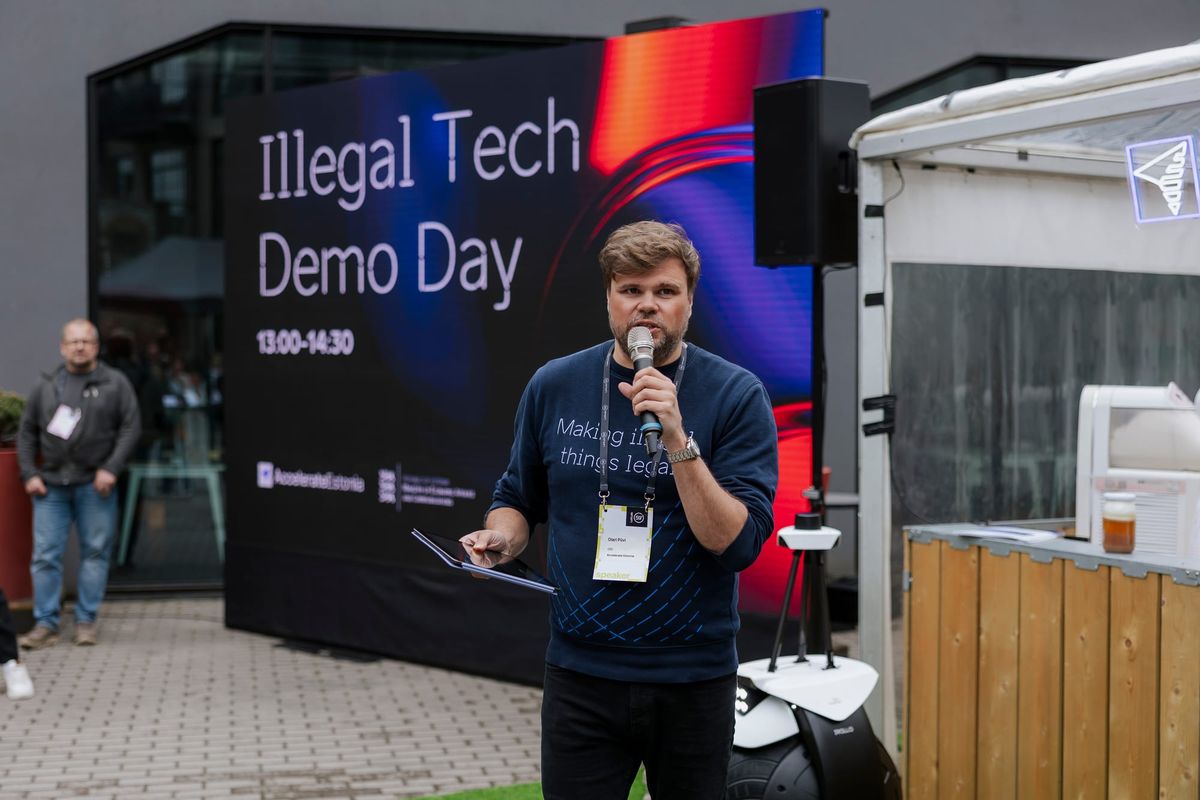
What if your problem is not your runway or your technical challenges, but instead the law that says that what you want to bring to market is not legal? What then?
In a cooling economy with fewer and fewer founders, the state’s immediate reaction to liven things up is by offering some sort of financial intervention - be it grants, subsidised loans, or other financial aid. There’s nothing wrong with that; cash is vital. It pays the engineering team, covers the co-working space, and ultimately keeps the lights on when private funding slows down, or you cannot seem to turn yourself cash-positive. What is it that's holding you back?
We pride ourselves on being a digital state, positioning Estonia as a frictionless place for innovative businesses. At the same time, if you need an aspirin in the middle of the night in Estonia, or have a sick child that needs medicine that you haven’t stocked up on, the law currently says that a pharmacist must physically hand it to you. Here, I find that the law fails both consumers and businesses.
An Estonian technology company, Grab2Go, has developed an autonomous pharmacy that provides a technical solution for purchasing medications 24/7 and offers access to professional pharmacist advice through video consultations. So the technology exists, the market need is there, but in the current Medicinal Products Act, an automated pharmacy simply does not exist, nor is it possible to sell medicines without the physical presence of a pharmacist at a pharmacy.
As the original legislation could not predict robotic pharmacies when it was created decades ago, we can excuse this situation to a point. However, when a legal framework restricts a business from entering the market with their innovative and much-needed solution, and a patient’s access to essential services, the regulation requires an urgent update.
We change the laws so that businesses don’t have to change their solutions
This friction is why Accelerate Estonia exists. Our aim is to serve as a bridge between high-stakes innovation and the state's legislative machinery. We see regulation not as something written in stone, but more like software that requires continuous debugging.
There are strict criteria for evaluating companies on whether they are eligible for our program:
- Is there a clear regulatory barrier?
- Does the solution have the potential to tackle significant global challenges?
- Is the product or service ready for piloting?
When the Minister of Economy and Industry Erkki Keldo publicly wore a sweatshirt featuring our mission - ‘Making illegal things legal’ - it turned heads. While the statement may seem controversial at first, there is actually a real policy objective behind it.

We are introducing a comprehensive, cross-sector experimentation framework that will allow real life testing of technologies that do not fit into the current legislation. It’s not an official licence to ignore the law, but a structured and supervised testing ground with clear risk-mitigation measures.
The economic case for this approach is clear. International data indicates that startups participating in structured regulatory sandboxes raise around 15% more capital. In the context of Estonia, that increases the average transaction from €7.1 million to €8.2 million. Preliminary analysis suggests that companies participating in Estonian regulatory sandboxes could raise nearly €1.7 billion over 10 years, generating high-value tax revenue and specialised jobs.
Turning grey areas into export plans
Five out of the top twenty startups in Estonia (in terms of capital raised) required at least some regulatory change to enable their business model to prosper. When Bolt introduced their first scooters or Starship rolled out initial delivery robots, they operated in a grey area. At the time, a delivery robot did not legally belong on a sidewalk, nor did it belong on a road.
While temporary agreements and one-off legislative changes allowed those companies to survive and scale, relying on legal ambiguity is not a great strategy. Operating in a grey area creates risk, lowers valuation, and holds off investors who need legal certainty before committing.
Our goal is to flip this process entirely. Instead of forcing founders to use legislative loopholes until the state notices, the state is inviting founders to co-create the rules to fit their products.
Once the innovative solution is successfully integrated into Estonia’s legal framework, that company possesses a regulatory blueprint that can be exported to other, more lucrative markets around the world, using Estonia as the launchpad.
If Estonia wants to maintain its position as a seamless digital society, our primary competitive advantage cannot be limited to ease of company formation or digital services alone. It should also be our willingness to support novel businesses in taking down legal barriers that stand between their innovative solutions and a global market.

Comments ()