How Gridio ended up between a rock and a hard place - car makers on one side and energy suppliers on the other, and why that is a good place to build.
In January 2020 my cofounder and I closed Gridio’s first funding, €300,000, with an ambitious plan to sell European energy utilities a technology that turns homes into virtual power plants. A product deck, without a working product, landed us pilots with six Nordic utilities.
Looking back, that still astonishes me. Three electrical engineers in Istanbul built us a smart energy controller for $500, and nine months later around a hundred homes in Finland and Sweden were heating their water whenever the energy market signalled it.
It looked like success until reality caught up. We asked our utility partners how quickly they could roll the product (a smart box plus a web app) out to their residential customers. Their estimate was four years for a few tens of thousands of homes. That was not the hyperscaling we knew we needed.
We promised ourselves two things. Stay away from hardware that is hard to distribute (read: anything installed in people’s homes). And stay away from energy companies, where innovation tends to mean testing new things rather than putting them into production.
Back to the energy suppliers
Fast forward six years and Gridio has kept only one of those promises. We are now one of the leading software platforms in the EU for matching electric car charging to energy markets, and we are back to selling to energy suppliers. Why? They certainly have not started moving much faster. But for a scaleup, energy suppliers are like opinions: everybody has one.
If you want to win the energy market of a whole continent, getting into bed with them is a lot easier than trying to push them out, and critically you are not likely to get kicked out either.
Electricity suppliers are not slow by nature. Like any corporate running critical infrastructure, they need time to assess risks and remove them before they shift from neutral into first gear. Three things speed this up: a consultant’s mindset, a proven product and, best of all, competition.
Be their consultant
Earlier in my career I worked at the world’s largest mining company, another industrial corporation.
One thing everybody there loved, top management most of all, was external consultants and their reports. Outside expertise gives you an ‘independent’ opinion to fall back on when you justify a decision, a project or a budget.
If a respected firm says the EV market will grow 30% a year, it is much easier to convince your budget holder than if you worked it out yourself in Excel.
So the first rule is to sell your know-how together with the product. At the very least, share what you have learned as a startup about moving fast – corporates love that. Some of your clients may even want to come and work for you (happened with a big car OEM). Be their internal consultant. Do not wait for your champion to ‘develop internal strategic alignment’ or confirm ‘product roadmap fit’. Do that work for them. Then you are selling strategic insight and a product together, and that combination is much stickier than software alone.
Prove the product somewhere else first
A proven product helps too. Back in 2022, true to our two promises, Gridio launched a new product line: a smart charging app that skipped the charging hardware altogether and controlled electric cars directly through the car makers’ clouds.
A driver only had to log in to Gridio with their car account, and we could read the battery level and send charging commands as if we were the driver. It worked well with consumers. We reverse-engineered car apps one by one, built our service on top of them and grew to 30,000 connected EVs. When we turned the free app into a €3.79 monthly subscription, about 40% of our customers stayed.
When we started selling to energy suppliers, they were impressed on one count. We could not only distribute a smart charging app, we could charge a monthly fee for it, while they had planned to hand theirs out for free to win customers. They were less impressed when we explained that the whole service relied on imitating the driver towards the car makers. Legally, that is a grey area at best.
Instead of arguing the point, we bit the bullet and went to the car makers ourselves. We asked them to build official access so Gridio could serve drivers and energy suppliers. At first they did not budge. Since 2025 we have signed API agreements with car groups covering 27 brands and about 80% of new electric cars sold in Europe. So when BMW stopped allowing companies to imitate drivers through its app in September 2025, we were one of the few companies still able to smart charge those cars. Energy suppliers noticed.
Let competition do the selling
The third accelerator is the one, I, as a founder, control least, but it works the best. An energy supplier rarely moves because a startup has a good idea. It moves when a rival launches something its customers might want.
Right about the same time that Gridio launched its smart charging to consumers, two new energy suppliers moved in to the space. In the UK, Octopus Energy showed what this looks like. Its smart EV tariff charges cars automatically at the cheapest hours, and EV drivers signed up in large numbers. Octopus has since entered Germany, France, Spain and Italy, and suppliers in those markets now hear the same question from their boards: what is our offer for EV drivers? In Norway, Tibber did the same.
Instead of selling Gridio, we started selling survival. If you want to survive as an incumbent energy player, well then you need to compete with energy company startups by having the same technology in your stack. And that really resonated, eventually.
As the EV market is set to more than double in 2026, Gridio is armed with the widest portfolio of official car-maker partnerships and the race for the electricity consumer is heating up, our years of internal consultancy are paying off. In twelve months, we have gone from working with two energy suppliers, to now working with 26 energy suppliers in various stages of onboarding. Together they account for one in six electricity consumers in Europe (see above re sharing a bed is more scalable, than kicking someone out).
Why the slow path is sticky
Selling to energy suppliers is slow, and it will stay slow. A first meeting can take months to become a trial, and a pilot can take a year to become a contract. But once a supplier has put smart charging into its app, connected it to its trading desk and told its customers about it, switching to someone else becomes a project of its own. The car makers work the same way.
Each official agreement took us years, but now we are vetted and we are even using contracts with our signed OEMs as proof that other car OEMs should follow suit.
We are indeed between two dinosaurs – or a rock and a hard place. But once you find a space between them, its hard to nudge one away.
Car makers decide who can talk to their cars. Energy suppliers own the relationship with the household and the electricity bill. Gridio sits between them, and both sides are slow to let anyone in. For a startup, that is painful in the first years but in our scaling phase, we see that as our asset not a liability.
Six years ago we walked away from energy suppliers because they were too slow. Today we work with them because they are the fastest way to bring smart charging to millions of European homes. We still have no hardware to install, so a supplier can offer Gridio to tens of thousands of its customers in weeks, not four years.
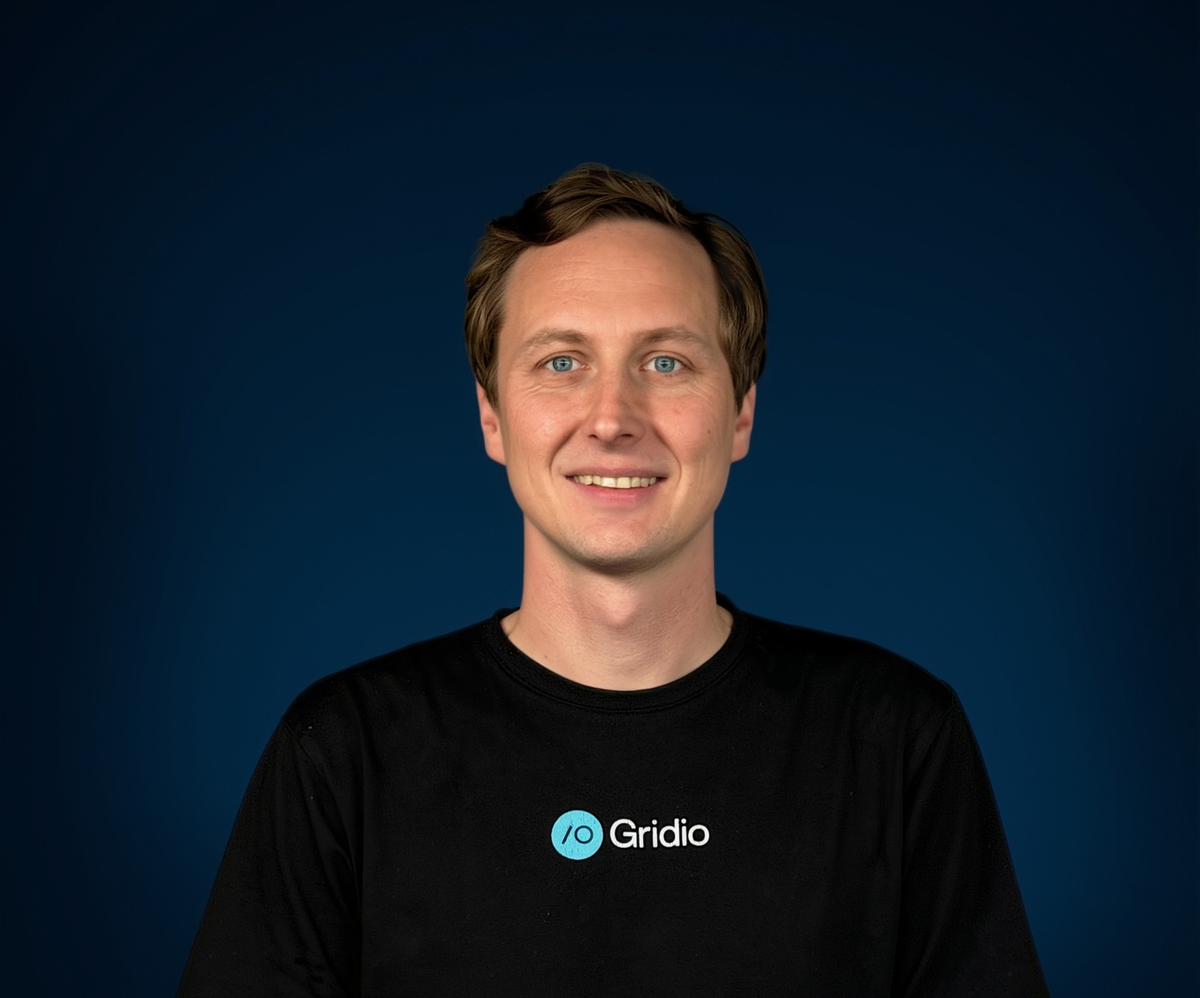
Konrad Hanschmidt is cofounder and CEO of Gridio.



Comments ()