
TALLINN - In 1992, Silicon Valley tech investor Andrew Thompson arrived in the newly liberated capital of Estonia carrying bags packed with boots, clothes, and tinned food. The shops in Tallinn were entirely empty. The Soviet occupation had left the Baltic nation flat on its back financially.
Thirty years later, Thompson stood on Toompea - the historic hill housing Estonia’s government - and looked out at a completely different country.
"I look and think, 'Good grief, there's two Bentleys and a Ferrari,'" Thompson recalled in an interview. "Now there's definitely a lot of wealthy people here."
Between those two visits lies one of Europe’s most remarkable economic transformations. Estonia's GDP per capita had risen from roughly $1,000 at the dawn of independence to surpass that of Japan.
Thompson has quietly spent decades building the critical bridges linking Estonian innovation to Western capital, global defence networks, and Silicon Valley. Through his family foundation, he has funded memory institutions, launched academic programmes at Stanford University, and helped establish the Creative Destruction Lab (CDL) Estonia, a high-powered accelerator now routing international defence and tech experts directly to Tallinn.
The driving question for many looking at his portfolio is simple: Why Estonia?
A heritage forged in flight
Thompson’s deep alignment with the country began not in a corporate boardroom, but through the remarkable survival story of his late mother-in-law, Olga Kistler-Ritso.
Olga’s father, the son of a freed Estonian serf, beat the odds to become a doctor in the early 20th century. He moved to Kyiv to tutor a wealthy family, married their daughter, and started a life that was quickly upended by the Russian Civil War. While attempting to flee back to Estonia via Moscow, Olga's mother died, and her father was arrested and shipped to Siberia. Olga, just two years old, and her seven-year-old brother, Aadu, were left abandoned in Moscow for six months.
Desperate to save them, her father scribbled a letter detailing their location and threw it from the window of his prison train. The note was miraculously found and delivered to his brother in Estonia. Olga's uncle tracked down a railway worker willing to smuggle himself into Moscow, successfully rescuing the two stranded children and bringing them back to Tallinn.
Olga grew up to become a doctor herself, but history repeated itself in 1944 when Soviet forces returned to occupy Estonia. Fearing the mass deportations and executions that marked the first wave of occupation, Olga fled west as a refugee. She eventually arrived in the United States in 1949, retrained as a physician, and later married Sylvia's father, Swiss native Walter Kistler.
"I love my country, but I love freedom, and I just wanted to be free," Olga would tell Thompson later in life.
When the Berlin Wall fell, Olga chose to use her own family resources to help rebuild her homeland, establishing the Kistler-Ritso Foundation alongside her husband, Walter. In 1995, that effort culminated in the creation of Tallinn’s Museum of Occupations (now Vabamu), dedicated to preserving the memory of the Soviet era and honouring the "Forest Brothers" resistance fighters who were fighting Soviet soldiers in the woods here until 1976.
The leapfrog strategy: 'Tiger Leap'
Thompson, who arrived in Silicon Valley in 1987 and began launching healthtech and venture companies shortly after, watched closely as the newly independent Estonian state began to govern itself.
He notes that between 1990 and 1992, while still technically transitional, Estonian leaders held rigorous internal dialogues about what kind of country they wanted to build. The consensus was sharp: immediate free markets, flat taxes, and a radical pivot toward technology.
"Every little country has to have a thing," Thompson explained, citing conversations with Toomas Hendrik Ilves, the former Estonian President. "If we try to catch up with the rest of the world, we'll be 30 years behind forever. So, where's the leapfrog? And what he saw was Netscape. Let's make that our thing."
The policy decisions that followed were incredibly bold for an impoverished nation. In 1995, Estonia launched the "Tiger Leap" initiative, placing a computer on every child's desk. Citizens have been voting securely online since 2005.
According to Thompson, this rapid adoption succeeded because Estonia prioritised democratising tools for its people over using technology to expand government bureaucracy.
"One of the things that Estonia has done really, really well is to drive technology to its citizens, rather than the government using it for its government, or for its bureaucrats or for its corporation," he said.
From venture capitalist to state decoration
Thompson brings an intense operational background to his mentoring and philanthropic work, having scaled multiple companies and navigated major Fortune 50 transactions and public listings in the world's most advanced tech economy. "I bring a set of perspectives that aren't... fully applicable, but they, I think that... they're just really valuable, they're just different," he noted.
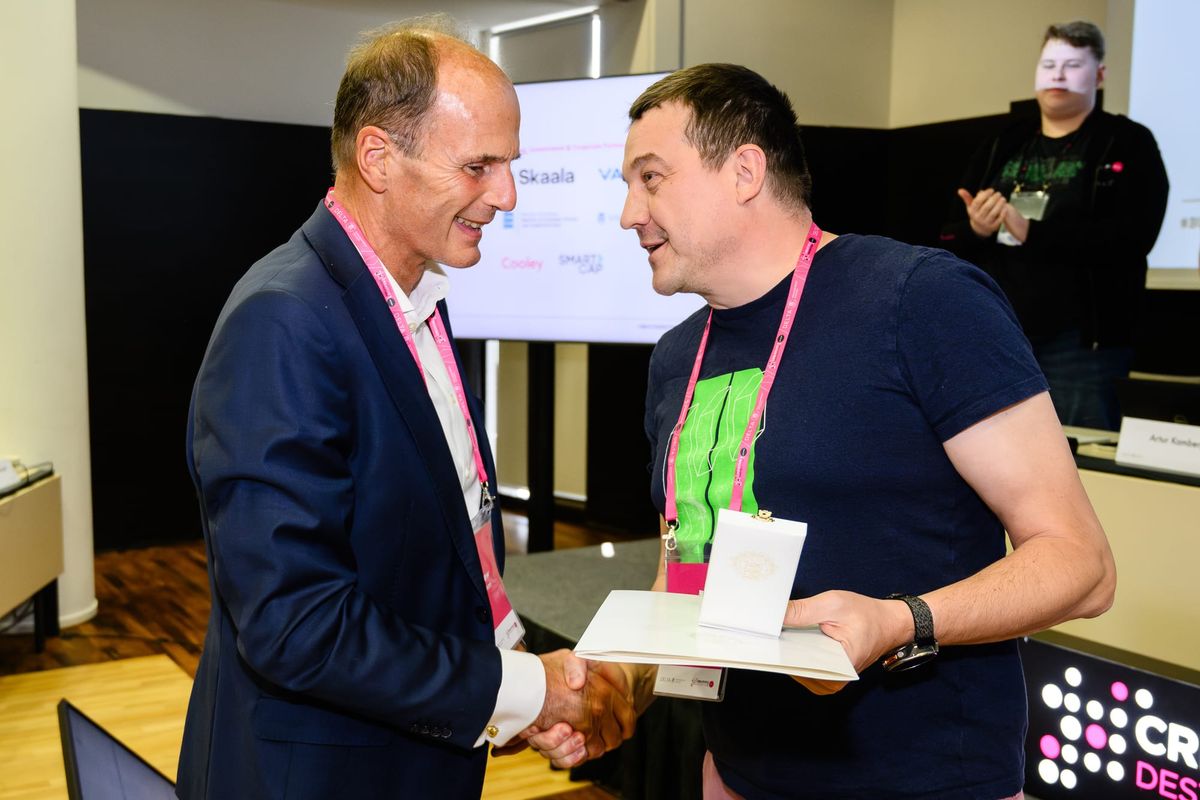
His decades of quiet infrastructure-building and advocacy did not go unnoticed by the state. This year, the President of Estonia awarded Thompson the Order of the Cross of Terra Mariana, 4th Class (Maarjamaa Risti IV klassi teenetemärk), one of the highest honours the country can bestow upon a foreign national for exceptional services to the Republic of Estonia. Upon receiving the award, he said it was 'very flattering really'.
Silicon Valley to Tallinn: Infecting the system
To solidify this technological trajectory, Thompson and his wife, Sylvia, sought to create permanent, structural pipelines between Estonia and their alma mater, Stanford University. Working alongside Stanford University Librarian Michael Keller, they endowed a permanent Baltic Studies programme.
The initiative acts as a multi-generational exchange programme. Every year, a dozen Estonian academics travel to Stanford on fellowships, while 20 to 30 Stanford undergraduate students travel to Estonia for summer internships.
"The idea is to infect them with networks," Thompson said. "We're showing people, not telling people."
The exchange also brings American public education leaders together with Estonian policymakers to figure out how to integrate artificial intelligence into standard school curricula. While traditional education systems in countries like Ireland hesitate to implement AI for fear that teachers won't know what students actually comprehend, Thompson champions the aggressive stance of Estonian Education Minister Kristina Kallas.
"Her point is that we don't have time for that; we know the kids are already using it," Thompson said. "So the way to actually get a rocket up for teachers is just mandated for the kids. Now you've got to figure it out."
CDL Estonia: Building strategic deterrence
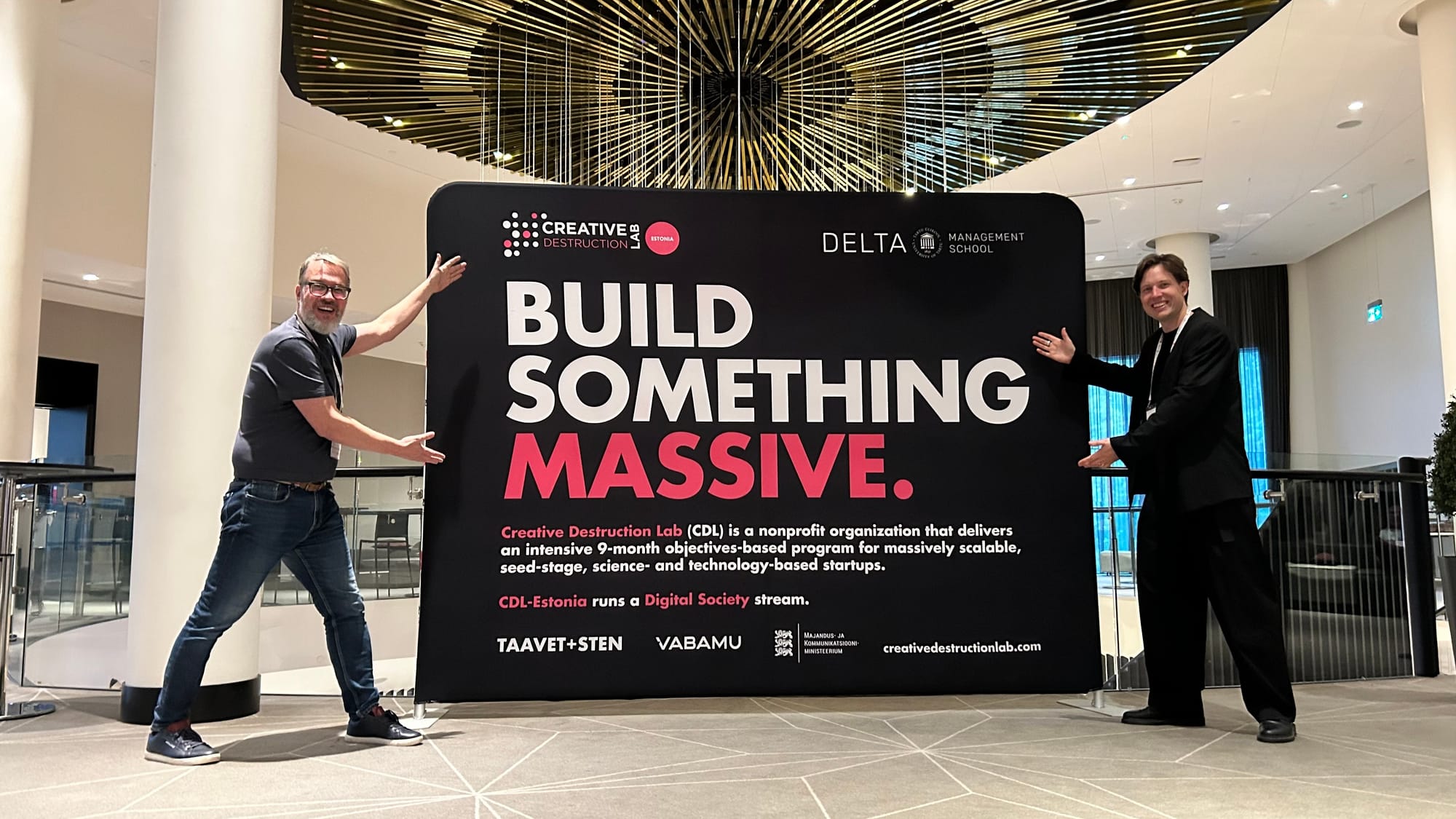
Perhaps Thompson’s most significant recent contribution to the regional economic ecosystem is the establishment of the Creative Destruction Lab (CDL) in Tallinn. Originally founded by Canadian economist Ajay Agrawal to scale science-backed companies, Thompson insisted that a node must be built in Estonia as a condition of his financial backing.
Sponsored by his family foundation, the programme's core mission is explicitly geopolitical: "Keep Estonia free, keep the region free, keep it from authoritarian rule."
The best way to do that, Thompson believes, is to build overwhelming economic resilience and strategic deterrence. Following Russia's full-scale invasion of Ukraine in 2022, CDL Estonia shifted its focus heavily toward defence innovation.
"The best way to prevent kinetic war isn't to be fighting one; instead, have it not start in the first place," Thompson remarked.
Rather than focusing on traditional weaponry like "bombs, bullets, and ballistics," the Tallinn-based accelerator focuses on tech-driven security: cyber resilience, protecting undersea pipelines and cables, and combating internet misinformation.
To make it work, Thompson cashed in decades of personal and professional relational capital. He persuaded prominent global figures to fly to Estonia on their own dime to mentor local startups. Among them are Tom Hurd, the former Director-General of the UK's Office for Security and Counter-Terrorism, and Brian Hendrickson, an early leader within the U.S. Department of Defence's Innovation Unit.
The programme operates as a robust coalition, backed by Thompson's foundation, local tech entrepreneurs and state entities.
The capital problem: Where Europe fails
Despite his enthusiasm for the Baltic-Nordic region, Thompson is unsparingly candid about the systemic barriers holding European tech back compared to Silicon Valley.
"Europe is really, really good at inventing things," Thompson observed. "They're less good at translating inventions into products, and they are really not good at translating products into scaled businesses."
He attributes this failure to a mixture of over-regulation in major economies such as France and Germany and an academic culture that treats commercialisation with scepticism. At Stanford, he notes, a STEM professor can rarely secure tenure without proving their research can survive the marketplace. In Europe, that mindset is often absent.
There is also a deeper, structural pool-of-capital crisis plaguing the continent, particularly the United Kingdom. Thompson points to well-intentioned British pension reforms enacted under former Chancellor Gordon Brown that forced corporate funds to report liabilities on their balance sheets. To mitigate risk, insurers liquidated high-yielding equity assets and moved them into low-yield government gilts.
"This is an unbelievable tragedy for Britain... it has decapitalised Britain's stock markets," Thompson warned. While U.S. institutional funds actively fuel the venture capital market — with Stanford's $50 billion endowment allocating roughly 20% ($10 billion) to alternative assets, a stark contrast to starved British ecosystems.
Estonia and the wider "Nordic-Baltic Eight" represent Europe's best counterweight to this stagnation, precisely because they maintain a bottom-up, market-driven approach.
A culture unafraid
When he isn’t running corporate strategies or organising defence hackathons, Thompson retreats to a traditional farmhouse he owns on the island of Saaremaa. There, surrounded by meadows, cranes, and a neighbouring sheep farmer, he connects with the local authenticity that he fears major Western societies are shedding.
For Thompson, Estonia's true superpower is its unyielding grip on its culture and soft power, which allowed a population of just 1.3 million to survive decades of brutal Soviet assimilation. It is an identity fully on display during the country’s massive, multi-generational song-and-dance festivals.
"One of the really dangerous things about life in America today is that whilst we are creating more and more hard power, we are losing soft power," Thompson said. "If you don't have soft power, you have hard power. Soft power is really, really powerful."
It is this profound, collective cultural confidence that feeds directly back into the nation’s economic resilience and defence posture. When asked whether he worries about holding land and running businesses next door to an aggressive Russian state, Thompson cites the Estonian people's baseline preparedness.
He recalls a telling exchange at the Lennart Meri Conference in Tallinn, where international attendees asked the Chief of the Estonian Defence Forces what would happen if Russia invaded.
"He said, 'Look, we're not NATO's doorman, and we are not going to wait to be invaded. If we thought the Russians, by gathering force on our border, were going to invade, we would invade Russia," Thompson recounted with a smile.
"I love it. That’s forward thinking... These are great people who got their elbows out."
Comments ()