
Doctor-founder plays the long game to shorten hormone testing
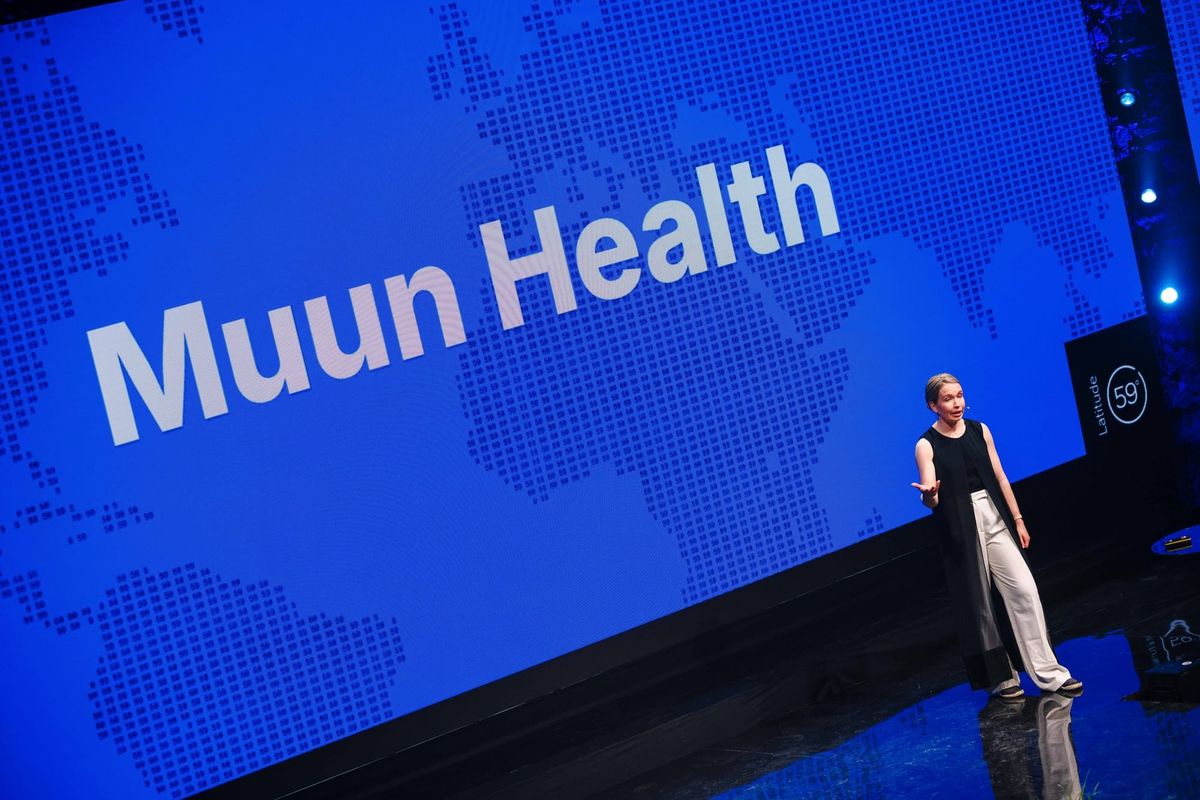
At the 2025 Startup Awards, Muun Health took home the HealthTech of the Year Award. The company is busy creating a wearable continuous hormone monitor in a research lab at Tallinn’s TalTech University. I caught up with CEO and co-founder Kerli Luks about how the deeptech is coming along and what inspired her to create such a product.
I catch her on a busy day. She has just submitted a grant proposal for European funding and earlier took part in a pitch competition. All in a morning’s work of a busy CEO and startup founder.
We’ve never spoken before, so I’m keen to get a little background. She tells me she grew up in Pärnu, informs me I need to visit Estonia’s summer capital and tells me her upbringing was a curious one - she was always active and the first to try everything. Sounds like the makings of an innovator alright!
Her curiosity about how the human body works led her straight to medical school, but she was surprised to find that she had manifested that move years before.
“I don't know if it was a long-term dream or not - we found some notes at home. I must have been in the first grade at school, so very small, and it says that I was going to be a doctor. I don't even remember,” she says.
Well, that’s some first-rate vision boarding right there. I make a note to ask for manifestation tips later.
Despite loving her med school experience, Luks struggled to find a speciality, so she ended up going to Finland to practice medicine instead of doing a residency.
“I just thought it would be a year to think about what speciality I'm going to do,” she explains, "but yeah, that ended up being five years in emergency medicine.”
She returned to life in Estonia due to COVID and pregnancy, where she joined a private clinic and became aware of all the women who were struggling with their hormones, and all the testing they had to go through to figure things out.
“I think it's five to ten years that it takes for women to be diagnosed with hormone-related conditions after their onset,” she tells me. “So I was looking for solutions, maybe there's something out there that we could get to the clinic.”
Coming up short on this was the very reason she is now the co-founder of a continuous hormone-monitoring device startup. If they can do it for glucose monitoring, why can’t they do it for hormones? Ok, it’s not quite as simple as that, but that’s Muun’s job to figure out.
Back three years ago, when the company was founded, it was really in a space of its own, but more recently, they have seen competitors coming to the deeptech space, and hormone monitoring has been given extra validation with the creation of the SPRIND hormone challenge.
The SPRIND Continuous Hormone Monitoring Challenge is a €40 million pan-European programme to develop real-time, wearable biosensors that track female hormones, being led by Ida Tin, a Danish femtech innovator.
Aside from improving accuracy through continuous hormone monitoring, the data could also inform clinical trials. Imagine a world where females would not be excluded from clinical trials because of the unique nature of their systems. Just imagine!
So, how exactly will this work? “The aim is that the woman doesn't have to use it the rest of her life - we see that the woman would need it in different stages of her life, right? But the aim is for the data to be used to build predictive AI models, so that if you use it for three months in a row, the AI model can make really accurate predictions. It depends, of course, on the specific use cases,” she says.
It could lend itself to plenty of use cases, initially being for those trying to conceive but also for PCOS, endometriosis, a contraceptive, perimenopause and post menopause.
Currently Muun is still in the lab Luks tells me, “so it is deeptech - there's a reason why nobody has done it yet.” This is not as simple as a wearable with one reference point, “we are doing a long-standing wearable that enables continuous, real-time monitoring, [and this] needs some technical challenges tackled.”
“We have been able to build a lab prototype, a sensor system - but it still needs optimisation. It still needs miniaturisation. It still needs access to the interstitial fluid, and then it needs clinical validation. So we are still years before entering the market, it is a medical device, meaning that it needs larger clinical trials - we are targeting our MVP for next year,” says Luks.
Working on something that has such a long finish line sounds utterly exhausting. I ask Luks if she ever has doubts about why she started it in the first place. Turns out she doesn’t, she’s pretty obsessed.
“I think about the Muun all the time. I am obsessed. I haven't read a book in two years,” she says, telling me that that would just be a distraction. “With this huge grant now only focusing on continuous hormone sensing, there is so much validation for me that I'm really doing the right thing. I was on to something three years ago when I had this idea.”
Alongside Luks as a co-founder is Kerli Kustola, COO, and core team member Allan Tobi, who is CTO and Head of R&D. “The three of us have different expertise, but we really complement each other with our expertise,” she says. Luks also tells me that Muun also uses a lab in Spain and has advisers in the Czech Republic, Italy, the Netherlands, Germany and the UK.
As we wrap up the call, I ask her, " What’s the dream? “To become the first health tech unicorn in Estonia,” she replies.
Sounds about right. Watch this space!

Comments ()