

Too often I hear that “US democracy and the American dream are dead”. I couldn’t disagree more.
Let’s zoom out for a moment. The US has always had flaws, and achieving the American dream has always been hard.
Throughout its 250-year history, the US has endured numerous dark chapters: slavery, a civil war, the Great Depression, presidential assassinations, the terrorist attacks of 9/11, major financial crises and prejudice against immigrants (including the now successful Irish and Italian communities). Women were even denied the federal right to vote during the nation’s first 144 years.
Fast forward to the present, and yet another shadow hangs over the nation. The White House is occupied by possibly the most corrupt president in the nation’s history and one of its least popular. According to a J.P. Morgan report, a Trump Family Enrichment Tracker “shows $3.4 billion in crypto gains, media settlements, licensing fees, planes, PAC payment of legal bills and other sources.”
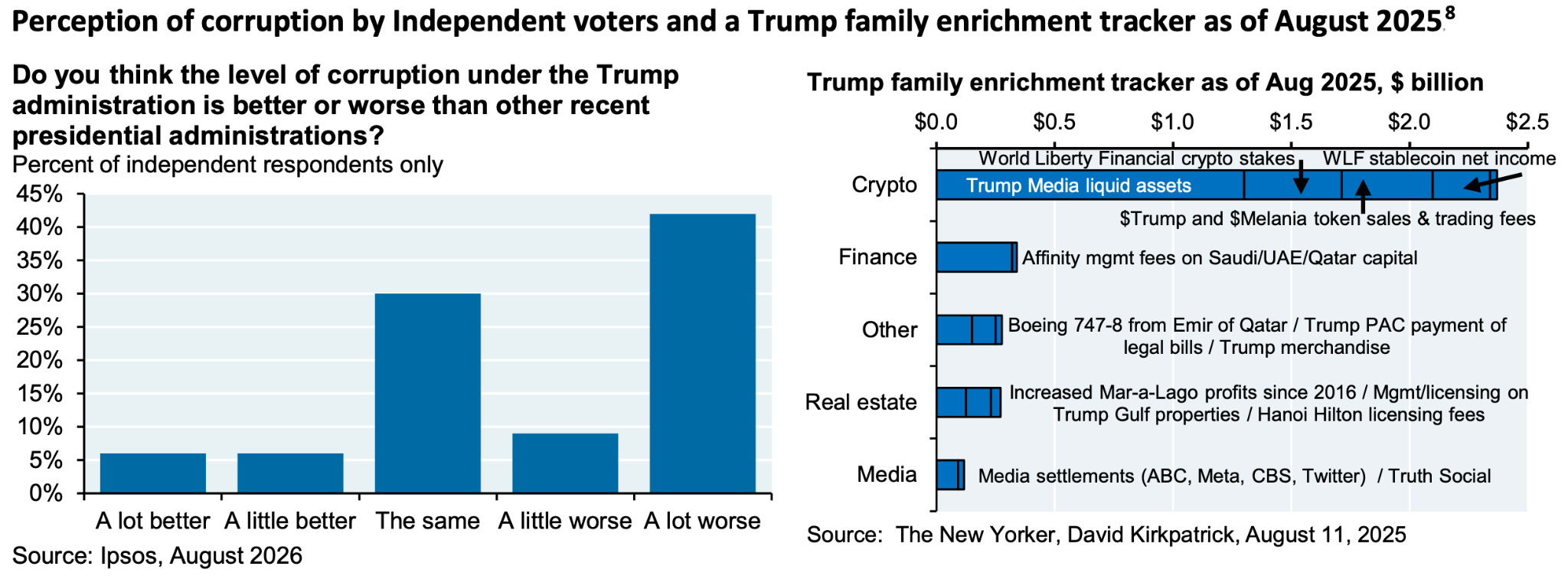
The good news: America isn't defined by any single president, but by resilient institutions armed with checks and balances.
Here are four major instances from this year alone when US institutions checked the presidency:
- Supreme Court: Trump tried to block voting mechanisms, such as mail-in ballots, to hurt the Democrats in these midterm elections. The Supreme Court firmly ruled against him, even though six of the nine justices lean Republican, and three were appointed by Trump.
- Central Bank (Fed): Trump recently appointed a new Fed Chair, which caused concerns that he’d be the president’s puppet. Despite persistent pressure from Trump to lower interest rates — a move that risked stoking inflation — the Fed’s new Chair increased interest rates instead, clearly exercising independence.
- Supreme Court (example #2): The Court struck down Trump’s central economic policy — the Liberation Day tariffs — ruling that such authority exceeds executive powers. Although Trump has attempted to preserve tariffs through obscure legal avenues, the decision underscores the judiciary's autonomy.
- Election Offices: The recent midterm elections were a bloodbath for Trump and his Republican party. More on this below.
Midterm Elections
Congress, made up of the Senate and House of Representatives, holds elections every two years. They are called midterms and are often viewed as a referendum on the president, since they occur two years into a president’s term.
The midterms this past 3rd of November were a bloodbath for Trump and Republicans, who previously held majorities in both chambers of Congress. American voters spoke their minds, flipping the majority of both chambers to the Democrats by an astonishing margin.

These were only the fifth midterm elections in the last 100 years in which the president’s party controlled both chambers and then lost them.
Republican Senate candidates lost in key states like Texas and Kansas, where a Democrat had not been elected since 1988 and 1932!
Voter frustration over higher living costs — driven largely by disrupted energy markets from Trump’s conflict in Iran and price hikes from his tariffs — heavily influenced sentiment. Rising healthcare costs and interest rates hurt affordability, and perceived corruption was another factor.
Trump faces an opposing Congress for remaining two years of his presidency
Controlling Congress gives Democrats the power to launch investigations, vote on presidential appointments for key roles, and exert strong leverage over budget spending and debt. Additionally, it provides them the ability to refine healthcare, Social Security and AI regulation.
Democratic leaders signalled a plan to aggressively scrutinise the “Trump crime family” and “hold the crooks accountable” for corruption.
Democrats have also pledged to “restore affordability”, which requires confronting tariffs and pushing an end to the Iran war.
President Trump remains in the driver’s seat for foreign policy and has veto powers. However, Democrats can place roadblocks to slow down his initiatives in Iran by withholding funding for the war, rejecting major military officer appointments, starting impeachment proceedings of top military personnel, holding hearings to scrutinise the administration’s decisions, escalating Trump’s decisions to the courts or dangling other carrots they control as a negotiation tactic.
In other words, Democrats will make it a living hell for Trump to continue escalating this unpopular war in Iran.
Loyalty to Trump has become toxic
Vice President JD Vance has quickly distanced himself from Trump by blaming the Iran war for Republicans’ wipeout in the elections. Vance has presidential aspirations for 2028 and may conveniently disassociate himself from Trump’s failed policies.
Other Republicans also sense Trump’s weakness. They are beginning to point fingers and distance themselves from Trumpism.
Trump is highly volatile and unpredictable, to state the obvious. We don’t know if and how he’ll react to this mounting pressure.
However, Trumpism is likely to decay over the next two years. Trump cannot run for another term and, as of now, any Republican presidential candidate would be foolish to run on Trump’s policies given his ultralow popularity.
The American Dream is alive despite the craziness in the White House
Which other country can rival the US's entrepreneurial and corporate success?
SpaceX recently IPO’d, creating 4,400 new millionaires of current and former employees, including technicians, welders, machinists and cafeteria staff.
Anthropic and OpenAI are possibly the most valuable startups of all time (and don’t forget that the world’s two most valuable companies, Apple and Nvidia, were once startups too).
The US is only 4% of Earth’s population, yet its stock market represents 65% of the world’s market capitalisation. It also boasts the globe’s deepest bond, private equity, venture capital and private debt markets.
Yes, America has a cruel side. Some succeed, many fail. Don’t lose your job or access to healthcare; you may not make it. Universities have become prohibitively expensive. Gun shootings and the gap between rich and poor are massive problems.
Succeeding in the US is hard, but don’t say the dream is dead because it’s difficult. It’s always been flawed, and it’s always been cruel, but the opportunities are unmatched anywhere else.
What’s next for Europe?
US voters have rejected the explosive growth in data centres, as seen in the midterms. According to J.P. Morgan, “Nearly every major local ballot measure opposing data centres won.” Constraints on new construction imposed by the new government may impact the 96 GW of power expected for delivery in 2028.
Countries like Finland, which have grid capacity, cheap electricity, access to 24/7 nuclear supply and cool temperatures, could be huge beneficiaries by attracting some of those data centres.
Regarding Ukraine, Congress will likely be more supportive of funding and intelligence sharing. Democrats will now have oversight on Trump’s dealings with Russia. Democrats warned that oil companies will be put on notice and possibly liable for facilitating Trump’s deal with Russia to release diesel reserves.
Even if Congress can put up roadblocks, expect a hard fight from Trump to keep his tariffs and the Iran war going. As I wrote at the onset of the Iran conflict, Europe is highly reliant on oil and gas imports. Natural gas prices have tripled in Europe since the war began, which will unfortunately make electricity and heating very expensive this winter.
Some damage is permanent. The trust Europe once placed in the US has been altered forever. Future US presidents will be keenly aware they can use (and possibly abuse) executive powers that were once unthinkable.
On the bright side, Trump did some good for Europe by forcing it to develop its own strategic industries and invest more in NATO.
The US has experienced many dark chapters before. Trumpism will decay in two years. The US will live on long after Trump.
----------------
Alejandro Jimenez is Founding Partner of TriHeritage Global Capital, an Estonia-based firm providing loans to scaleups and small companies.
Previously, Alejandro was a partner in New York and Geneva at J.P. Morgan, the world’s largest financial institution. He also ran the energy trading desk at Enefit and managed sustainable investment portfolios at Grünfin.



Comments ()