
The “Vinted Effect”: How Lithuania replicated the Skype phenomenon to rewrite the playbook
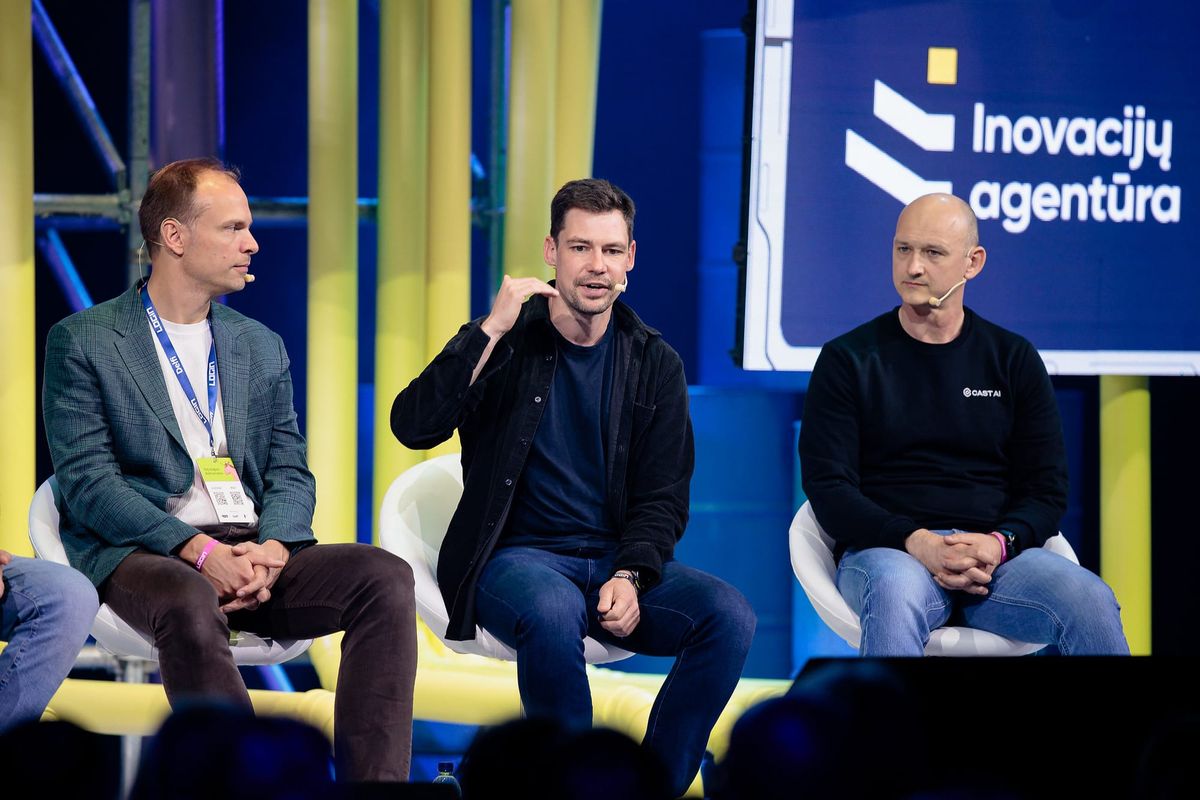
VILNIUS - When Mantas Mikuckas recalled the intense pressure surrounding Accel Partners' 2013 investment into Vinted, he framed it as a baseline trial for an entire nation. Addressing a packed hall at the LOGIN innovation conference inside the Litexpo exhibition centre in Vilnius, Vinted’s co-founder noted that international venture capitalists were fundamentally questioning if Lithuania was a stable, investable geography.
"Those investors were actually wondering, is Lithuania investable?" Mikuckas said on the LOGIN stage. "They even did due diligence on Lithuania—on the legal system, everything, and political stability—to decide if they can greenlight Lithuania as an investable geography."
Mikuckas framed Vinted's resulting $5 million Series A round as the first major international venture capital injection into a Lithuanian tech company since the country restored its independence in 1990. Crucially, the deal was struck directly with the domestic entity, Vinted UAB, bypassing the common practice of forcing international startups to "flip" their legal entities into jurisdictions such as Delaware.
While Vinted’s narrative remains the foundational pillar of Lithuania's modern multi-unicorn ecosystem, historical accuracy requires a minor footnote. Nearly a decade prior, Vilnius-born pioneer GetJar achieved global scale as the world’s largest independent mobile app store; however, its multi-million dollar investments from Accel were legally routed through a Delaware-incorporated entity, leaving Vinted to claim the title of the first institutional validation of Lithuania's domestic legal geography.
The Mid-Market Trap vs. The Baltic Advantage
This domestic focus has increasingly turned into the Baltic region's secret weapon, primarily driven by a geographic anomaly: small market size.
Martin Tantow, a Silicon Valley-based investor and partner at Pegasus Tech Ventures who also addressed the LOGIN conference, points out that startups born in larger mid-sized European markets often fall into a localisation trap.

"If you look at markets that are bigger — not as big as the United States, but kind of in the middle, let's say Germany, France, Spain, Italy — since they're bigger, they do focus a little bit more on their own country," Tantow explained during the panel. "They say exactly like, 'Oh, we are a German company' or 'a French company' ... which for me, again, is just not good."
In contrast, Baltic entrepreneurs are forced to look outward from day one. A firm founded in Vilnius cannot survive on local traction alone, compelling founders to build global architectures immediately.
"I wish that in Europe we would think at least European from the beginning," Tantow said, urging founders to adopt a broader framework: "We are a European company, and we are based in Lithuania."
Inherited Blueprints and Regional Anchors
This hyper-focused international mindset has created a reliable cross-border blueprint across the Baltic states. In neighbouring Estonia, early global champions like Skype laid a similar operational foundation.
Today, that regional playbook is best exemplified by transportation giant Bolt, which — despite raising more than a billion from Tier-1 global growth funds like D1 Capital Partners and automotive conglomerates — has intentionally kept its headquarters and core legal entity anchored in Estonia.
It is a validation of Lithuania's legal and economic maturity that Vinted proved possible in its own country in 2013.
Ultimately, both models are required to understand how the Baltics evolved from a blank spot on the global tech investment map into an integrated innovation hub that has yielded successive generations of software companies such as Nord Security and Cast AI.
Vinted proved that Lithuania could cultivate a long-term consumer marketplace capable of sustaining unicorn-level evaluations on native soil.
For Mikuckas, the evolution over the last decade has turned Lithuania from a speculative bet into an optimal launchpad.
"10 years ago, there was nothing. Now we have all the resources you need," Mikuckas concluded. "We have founders with experience, we have thousands of people who can join your company... we have money — local money, global money. I could not think of a better time, and a better place, to start your own tech company."


Comments ()