

HELSINKI — AI agents are increasingly touching payments, source code, and corporate data, yet most company servers leave them flying blind or force them to guess what they can actually do, according to a new benchmark released Tuesday by AI verification startup Suncly.
Suncly, co-founded by first-year IT students Kasper Muutra, 19, and Kristjan Hertsmann 20, in Tallinn, its an independent AI verification lab that tests whether AI agents and Model Context Protocol (MCP) servers actually do what they say they do.
Auditing 432 company Model Context Protocol (MCP) servers in the official registry by asking a basic question: what can an AI agent do? Suncly’s MCP Reliability Index found that three-quarters (74%) would not answer without a login, including servers tied to Stripe, PayPal, Notion, GitLab, and Figma, meaning users only discover an agent's capabilities after granting access.
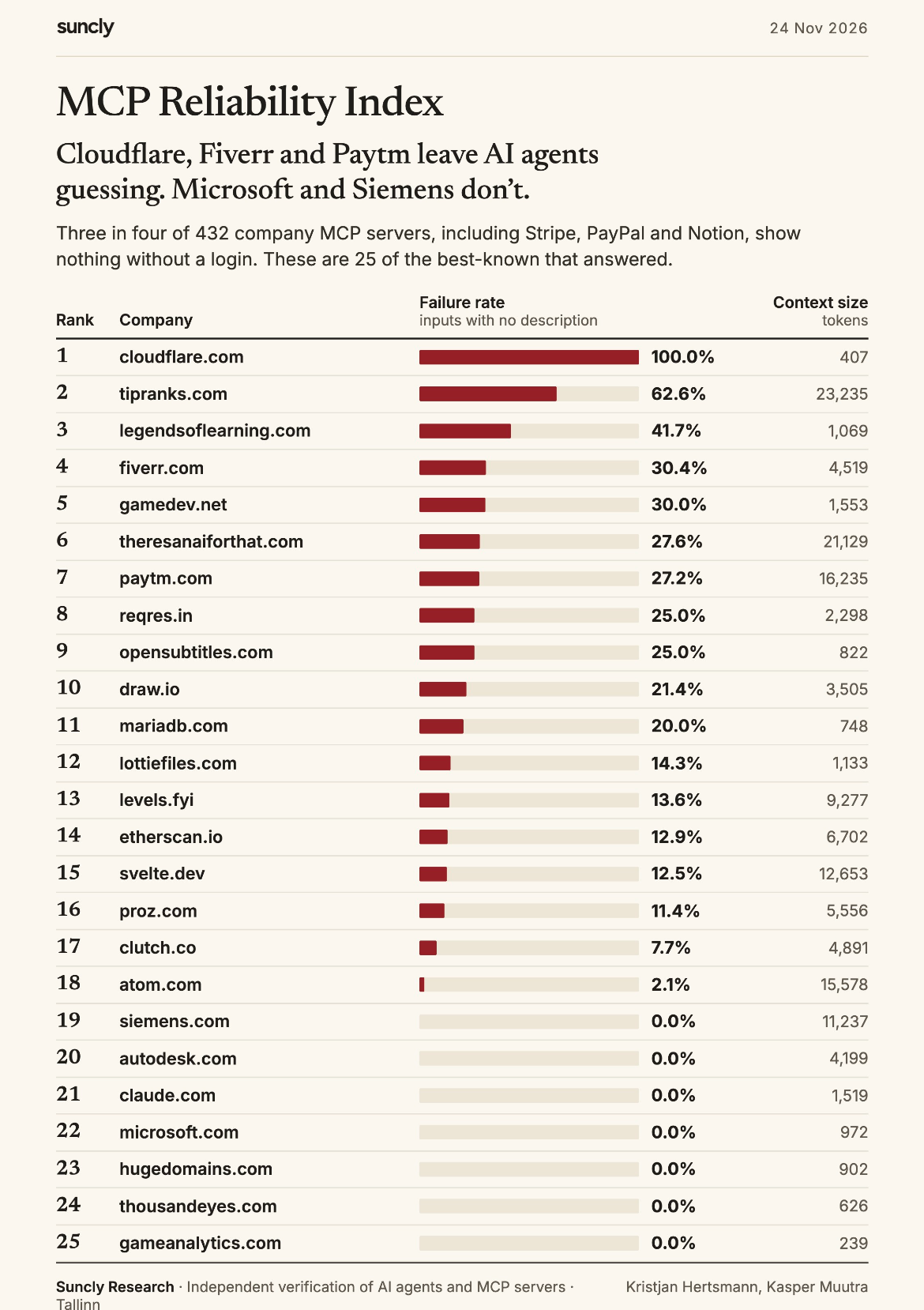
Among the 25 best-known servers that did respond without a login, 18 leave AI agents to guess at least one input. Cloudflare’s server topped the index for missing descriptions at a 100% failure rate across 407 context tokens, while Fiverr (30.4%) and Paytm (27.2%) left more than a quarter of inputs undescribed. By contrast, servers from Microsoft, Siemens, Autodesk, and Anthropic's Claude had a 0% missing-input rate in the index. Out of 22 of the world’s largest websites with an agent server, only three were both open and fully explained.
"We checked the public MCP servers of big companies to see if the big players also play safe," Muutra said. "Honestly, very interesting findings."
Continuous verification over annual checklists
Speaking with Fomo.Observer during Slush week, Muutra described the market as early-stage and rapidly evolving, with paying customers already on board. Rather than chasing short-term hype or vanity metrics, he said the founding team has focused on building core product reliability, tightening onboarding and testing flows, and planning toward a pre-seed milestone of €1 million in annual recurring revenue (ARR).
"The problem is big, and the market is still in its early phase," Muutra said during the Slush conversation. "First paying customers are already there."
He said that early manual testing took hours per run before Suncly automated workflows, cutting testing time to roughly 30 to 45 minutes depending on tool volume and complexity.
Independent third-party testing matters, he said, because developers and companies cannot simply grade their own homework when agents interact with external tools and live environments.
"It’s kind of like, you’re your own lab, and your lab can be pretty good, but you don’t really know how things behave in the real world," Muutra said.
What comes next
The MCP Reliability Index publishes the eighteen servers with input gaps among the 25 best-known responders, alongside seven well-known servers with zero gaps. Suncly plans a second release on December 17 that moves beyond static descriptions to call tools and test whether they actually do what they claim.
As AI agents become embedded in enterprise workflows, Muutra warned that bad assumptions and unverified tool behaviour carry growing security and operational risks, and that independent auditing will become harder to ignore as attacks and edge cases scale.



Comments ()