
'Nagu Naksti!' Ringy's Upgreat takeover marks a new chapter for circular economy startup
TALLINN - Ringy CEO Kristo Kraft stood at the counter of Upgreat, the largest retailer of used and refurbished electronics in the Baltics, wearing shorts and a white polo shirt embroidered with his company's name. It was 10 am on a cool August morning at T1, one of the city's largest shopping centres, and Kraft was something of a conqueror in this scene. Just 10 days prior, Ringy had acquired Upgreat for an undisclosed sum. Trind Ventures, a long-term investor in the six-year-old circular economy startup, supported the transaction.
Kraft was now the man in charge. This was his new domain. The refurbished iPhones, the restored laptops, the array of secondhand Apple watches, the workers unloading boxes: it was all Ringy. Rather than inspiring the fear and awe that one associates with any acquisition, Kraft was received in a friendly manner by the staff, though. It would be business as usual. There would be no changes. Upgreat would stay Upgreat. Ringy would stay Ringy. Life would go on.
If it isn't broken, Kraft said, looking around, a slight spring in his step, there's no need to fix it.
Friction in mergers and acquisitions is the norm in any industry. There might also be a quiet period before the restructuring starts and the blood starts leaking under the office doors. Concerning the Ringy and Upgreat deal, Kraft said that the latter's C-level executives were "super happy." The merger would allow them to grow the brand, open shops, and expand the factory.
Founded in 2020 – the same year that Kraft and three cofounders set up Ringy – Upgreat built its business through buying and reselling refurbished Apple devices across the Baltics, with stores at T1 and Lasnamäe Centrum in Tallinn as well as the Sāga Shopping Centre in Riga. At the time of Ringy's acquisition, the company reportedly had about 30 full-time employees.
While Upgreat's presence in Latvia and Lithuania is smaller, Kraft estimated that it had a 60 percent share of the Estonian market.
"What was attractive for us was that they have a working and well-known brand with physical stores," he said. "They have good sourcing contracts and a repair team. It was a good match."
Discussions around the Upgreat deal commenced in February. Kraft admitted that due diligence took months and was a "true rollercoaster" at times. "But the whole thing moved very quickly and then just like that, nagu naksti, here we are six months later."
There is a subtle irony to the deal too. Because, for some time, Kraft thought that Upgreat might be the company that would acquire Ringy. They were kind of different. Ringy sourced and sold internationally. Upgreat sourced and sold within the Baltics. But a combination did make sense.
"We always thought, maybe this is our exit strategy," said Kraft. Now Ringy owns Upgreat. Ringy probably won't stop there. Kraft sees the acquisition as potentially repeatable.
From Mõisaküla to the world
Officially, Ringy is headquartered in Mõisaküla. Located on the Latvian border, with a population of about 750 souls, it could barely be considered a town. Because of its address, though, Ringy has been featured several times as living proof of Viljandi County's thriving startup sector.
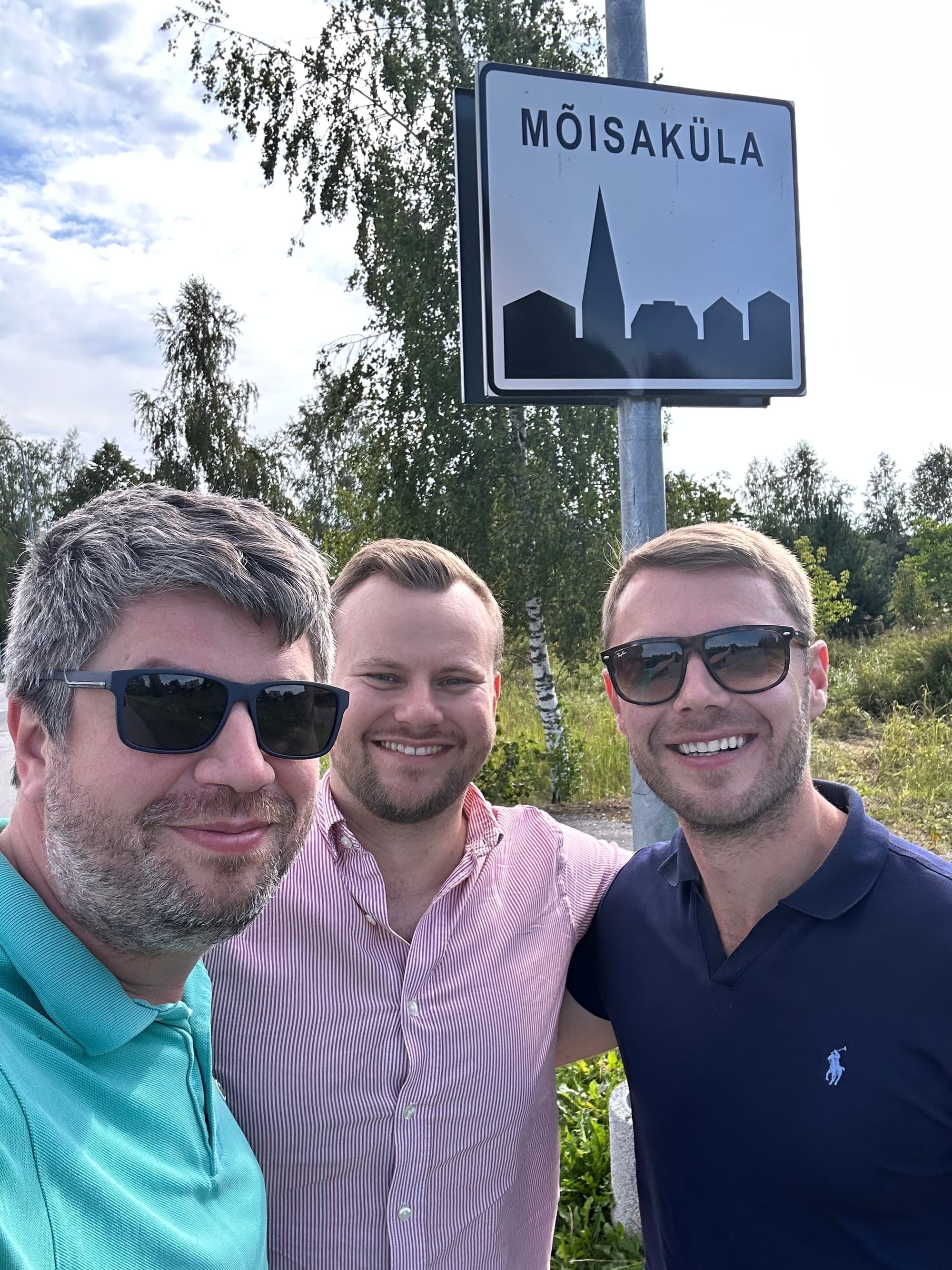
If one were to imagine a busy factory set back among the pines of the countryside, though, they would be mistaken. Mõisaküla is where Ringy cofounder Oliver Läll was born and raised, and he registered the company there in 2020. Läll, who previously was the CEO and cofounder of Streetbrand, an e-commerce platform, serves as Ringy's COO, and Ringy's operations are mostly in Tallinn these days. One reason Kraft chose to meet at T1 is that a wall is about to come down at Ringy's Mustamäe location. We'd all be covered in grey dust.
When Läll registered with Ringy six years ago, Ringy had no office at all. Kraft, Läll, and fellow cofounders Taavi Tuisk and CTO Ionut Iordachescu met to discuss a new startup during the pandemic. The quarter gathered at the Pirita Top Spa Hotel to share ideas. It was very discreet.
Then things started to move. Even before Ringy was incorporated, they were accepted into the Startup Wise Guys' first sustainability accelerator. Everybody brought something to the table. Kraft had been head of retail sales at LHV and an analyst and relationship manager at Nordea. Tuisk had been involved in logistics and waste management. Iordaschescu had been the CTO of a large Romanian media company. They had families and lives and didn't have time to build Ringy into a Silicon Valley-inspired startup, with matching t-shirts and table tennis matches. Instead, they had many sleepless nights and long calls after the kids were put to bed.
At first, they wanted to create a lifecycle app for electronics, giving users access to manuals, warranty information, repair links, and recycling guidance. The initial idea was to reduce electronic waste. As their vision for the firm wobbled, an accelerator evaluator wrote, "these guys are never going to make it." For Kraft and his fellow cofounders, that scepticism was welcome. "I think that was one of our biggest motivations throughout the years," he said.
By the spring of 2021, though, the company pivoted to reselling phones, laptops, tablets, and watches. At first, they saw themselves as a middleman, buying old devices from consumers and reselling them to partners like Foxway, which maintains a large factory in Tartu for refurbishing old devices. Something funny happened along the way, though. While negotiating with a major European marketplace for second-hand electronics, Ringy received a seller contract, even though their volumes at the time were well below the threshold for one. When they were offered the opportunity, the founders took it, and Ringy became a reseller too.
By the end of 2021, Ringy was running a small logistics hub in Tartu in an old building where, as Kraft remembers, the windows were so high no one could see out of them, and the toilet froze in the winter. The company was scaling, though. Läll even relocated to Tartu to oversee operations. Ringy started buying at scale.
Learning new languages
In retrospect, one must admire the hard-headedness of a group of founders who, Kraft admits, didn't know exactly what they were doing. If he has one regret, Kraft said that Ringy should have onboarded someone with experience in a business like the one it set out to create. During the initial business accelerator, he would jot down unfamiliar English business jargon at meetings and Google them later. "I didn't know what MRR was," he says, referring to monthly recurring revenue, "and all this stuff about 'runways.'"
Europe also began to open up for Ringy, as well as the world. Ringy partnered with a large French telecommunications firm. Doing business with the French was no different from doing business anywhere else in Europe, Kraft joked, "Only that all the contracts were in French." But, he added, there was more to the story. Ringy's team saw firsthand how busy the French market was for refurbished devices. Trade-in volumes in Estonia are small, Kraft said, and Ringy sells a yearly volume in just two months. In France, where refurbished phones account for nearly a third of devices sold, over 2,000 devices are processed per day. In Estonia and the Baltics, that share remains in the single digits for now.
Kraft believes that will change.
While observing how other markets operated inspired Ringy, it also got advice from companies that might one day be competitors. The head of sourcing from another industry firm gave Ringy pointers that it otherwise would have taken years to learn.
"In a way, we're the underdogs," Kraft said of Ringy, "but at the end of the day, the real competitor is the company selling new devices. There's room for more Ringys and Foxways."
Kraft added that attending conferences has also been important for the company's growth trajectory. The informal networking that arose had led to some of Ringy's breakthroughs. "Someone might simply say, after a few tequilas, 'Hey, I like you, let's make a deal," Kraft said.
Those deals have paid off, and the days of a cold warehouse with a frozen toilet are behind it. Ringy has matured into a business-to-business-to-consumer operation, with Central and Eastern Europe as its core market. It now sells to 28 countries with 24-hour delivery options.
Phones are about 90 percent of its trade volume, and it achieved profitability before the Upgreat deal. Its company culture remains small and homey. About 20 employees work there, many of whom are family members helping with packing. It continues to work with Foxway. Both firms buy and sell to each other, underscoring the sense of camaraderie among device refurbishers.
There is more to do, though, if Estonia is to become a little France, a country where a third of devices bought are refurbished. To make that happen, Kraft believes there are different stories to tell. An early and continuous selling point is that buying refurbished devices is a form of urban mining, one that can help greatly reduce carbon emissions as well as child labour.
"A smartphone contains 17 precious metals, 15 of which end up in the device," he noted. "All of these metals could be recovered from the millions of phones sitting unused in people's drawers."
Another story that needs to be told is that refurbished devices are trustworthy. That's where a physical presence matters, since it's easy to be suspicious of online warranty promises. "I could claim to be the king of Scotland, but that doesn't mean it's true," said Kraft. By having a store, customers have someone to talk to and, if necessary, yell at if something goes wrong. He's seen that impact in Latvia, where Upgreat has a site, than in Lithuania, where it doesn't. Upgreat had the same marketing budget for both countries, but Latvia has more customers.
Many resold devices have minimal issues. Sometimes they are gifts that the person didn't want, being resold straight out of the box. The most common issue is scratched screens, often caused by jewellery rubbing against them. These can easily be fixed. Kraft is, of course, a Ringy customer as well. He uses a refurbished iPhone 15 and a 2021 laptop that works like a charm, especially when negotiating a deal like the Upgreat transaction.
Which begs the question, what's next for the circular economy startup from Mõisaküla, Estonia? Expansion plans do exist. France could be an attractive market. The UK less so, because of post-Brexit tax complications. "I need to do everything by the book," Kraft said. The Upgreat model could be repeated, though, as physical shops give clients a certain peace of mind.
"We could be looking into something similar in some other geographical location at some point," Kraft noted, "but it's too early to say."
Comments ()