
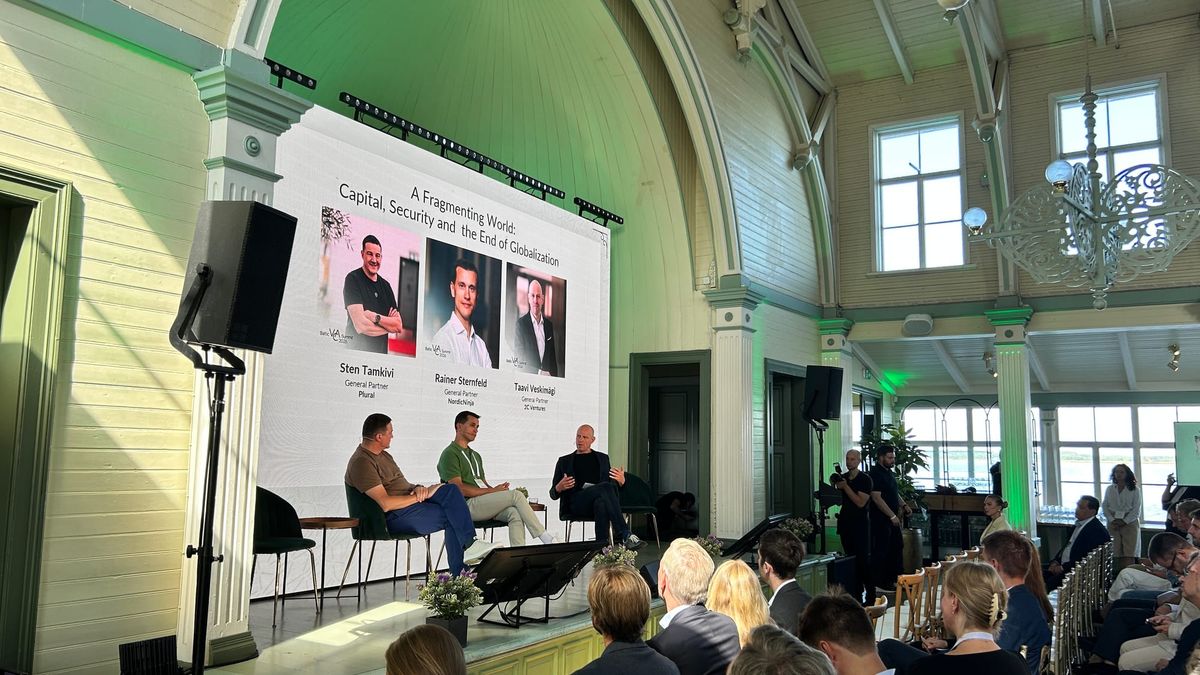
HAAPSALU - As geopolitical tensions accelerate the unbundling of global supply chains and capital flows, Europe's tech ecosystem faces an existential challenge: building indigenous technological sovereignty while overcoming its chronic shortage of late-stage growth capital.
At the Baltic VCA Summit in Haapsalu, venture capitalists and institutional policymakers converged on a shared reality — European innovators can no longer rely on foreign capital or external security guarantees.
The scale-up bottleneck
Addressing the opening panel, Sten Tamkivi, a partner at Plural, noted that while Europe has built strong early-stage startup hubs, the late-stage growth capital remains heavily reliant on Washington-aligned investors.
'When you now need to raise 50 million, probably you can still find a lead in Europe to get it done,' Tamkivi said. 'If you need to raise 200 million, you have to call the Americans. 10 years ago you also called the Chinese—you don't do that anymore because of the geopolitics.'"
"It's not about building tech for Europe; it's about funding global tech champions that happen to come from Europe... so that the big red button remains with us."
Rainer Sternfeld, partner at NordicNinja VC, framed this shifting geopolitical landscape as a necessary cycle of self-reliance.
"It’s not the end of globalisation; it’s just the bundling and unbundling cycle," Sternfeld said. "If every country in Europe had their own ASML-sized impact company, that would be a pretty good deterrence."
Re-engineering institutional capital
Bridging this scale-up gap requires massive injections of non-bank capital. However, local institutional investors, particularly pension funds, have historically faced regulatory and operational hurdles in allocating to venture capital.
Merete Clausen, Director at the European Investment Fund (EIF), pushed back against industry criticism of institutional risk aversion during a panel on pension capital.
"We should have less pension fund bashing and start instead finding solutions for them," Clausen said. "Not everybody can have a VC team of 20 or 30 people to do proper due diligence. Institutional investors need partners who can come along with them."
To address this, the EIF is expanding its European Tech Champions Initiative (ETCI) beyond its initial €4 billion deployment in mega-funds.
"This is really where we see the gap across European countries—it's the scaling-up problem," Clausen noted. "We are going to extend ETCI to mid-sized funds... and create an investment platform where we open up our portfolio to private and institutional investors."
The road ahead
While central bankers like Bank of Estonia Governor Madis Müller point to stabilising inflation and recovering Baltic exports, pension fund managers emphasise the need for long-term policy predictability.
For regional venture funds, the convergence of defence urgency, EIF co-investment structures, and expanded growth tickets offers a clear path forward if European capital can mobilise before its top innovators look across the Atlantic.

Comments ()